logo
Products
PRODUCTS DETAILS
Home > Products >
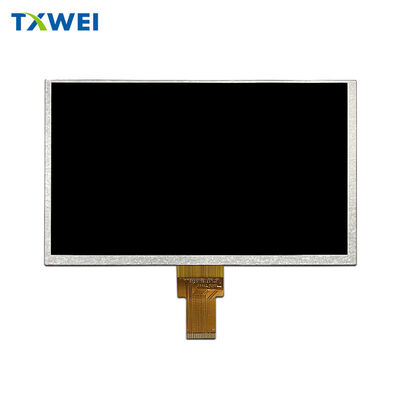
Factory wholesale 9-inch LCD screen 1024×600 full-view truck navigation display LVDS interface TFT screen

Factory wholesale 9-inch LCD screen 1024×600 full-view truck navigation display LVDS interface TFT screen

MOQ: 1
Price: negotiation
Delivery Period: 7-16days
Payment Method: L/C,D/A,D/P,T/T
Supply Capacity: 10000pcs
Detail Information
Place of Origin
shenzhen
Brand Name
TXWEI
Certification
CE FCC ROHS
Model Number
TXW900002B0
Number Of Pixels:
1024*600
Viewing Direction:
IPS
Display Interface:
LVDS
Brightness:
900 Nits
Active Area:
196.61*114.15
Outline Size:
210.7*126.4*5.0mm
Operating Temperature:
-30+80℃
Storage Temperature:
-30+80℃
Number Of Pins:
40pin
Display IC:
HX8282A11/HX8696A01
Highlight:

9-inch LCD truck navigation display

,

1024×600 TFT screen LVDS interface

,

full-view truck LCD display

Product Description

✦ TXW900002B0 | 9.0" Industrial TFT LCD Display Module ✦

➤ 1024×600 Resolution · LVDS Interface · Wide-Temperature · All-Direction Viewing

◆ Product Overview ◆

➤ The TXW900002B0 is a high-performance 9.0-inch TFT LCD display module engineered by Shenzhen Tianxianwei Technology for demanding industrial and automotive environments. This display delivers 1024×RGB×600 pixel resolution with 16.7 million colors, combining robust industrial-grade construction with advanced optical performance that professionals rely on.
➤ Built around a Normally Black transmissive TFT active matrix structure, the module integrates driver IC, flexible printed circuit (FPC), and a high-efficiency LED backlight into a slim 5.0mm profile. The LVDS differential signal interface ensures noise-immune data transmission across extended cable runs — critical for electrically noisy automotive and industrial environments.
➤ Operating reliably across an extreme temperature range of -30°C to +80°C, this display is purpose-built for applications where failure is not an option: motorcycle instrument clusters, electric vehicle dashboards, medical monitoring equipment, heavy machinery operator panels, and outdoor high-brightness installations.

◆ Display Technology & Optical Excellence ◆

▸ Resolution & Pixel Architecture
➤ The TXW900002B0 features 1024 horizontal pixels by 600 vertical lines, with each pixel composed of three RGB sub-pixels arranged in a stripe configuration. The 0.192mm × 0.19025mm pixel pitch delivers crisp detail across the 196.61mm × 114.15mm active display area. This pixel density strikes an optimal balance between information density and readability at typical viewing distances for dashboard and panel-mount applications.
▸ All-O'Clock Viewing Direction
➤ Unlike conventional displays that degrade when viewed from off-angles, the TXW900002B0 employs All O'Clock viewing technology — maintaining consistent contrast ratios and color accuracy from any 360-degree viewing angle. Whether mounted horizontally in a motorcycle fairing, vertically in a medical cart, or at arbitrary angles in construction equipment, the display presents uniform image quality without the color inversion or gamma shift typical of standard TN panels.
▸ Normally Black Display Mode
➤ The transmissive Normally Black construction ensures deep, rich blacks when pixels are in the off state. This characteristic maximizes perceived contrast in high-ambient-light conditions and reduces eye strain during nighttime operation — essential for automotive dashboards where driver fatigue directly impacts safety.

◆ High-Brightness Backlight System ◆

➤ The integrated backlight employs 36 white LEDs in an edge-lighting configuration, delivering 450 cd/m² luminance with minimum 80% uniformity across the active area. This brightness level ensures readable displays under direct sunlight exposure — a non-negotiable requirement for outdoor equipment and vehicle installations.
➤ The LED array operates at a forward voltage of 8.4V to 10.5V with typical current draw of 480mA. Under standard operating conditions, the backlight achieves a 20,000-hour lifetime (defined as time to 50% of original brightness at 30mA per LED). Engineers should note that operating current significantly impacts longevity; designs should implement current regulation to maximize service life.
➤ The backlight circuit diagram illustrates a robust parallel-series LED matrix with anode (A) and cathode (K) terminals, supporting flexible driver circuit designs for PWM dimming and overcurrent protection.

◆ LVDS Interface & Signal Integrity ◆

➤ The Low-Voltage Differential Signaling (LVDS) interface represents a cornerstone of this module's industrial suitability. Unlike single-ended interfaces susceptible to electromagnetic interference, LVDS transmits clock and data signals as differential pairs — rejecting common-mode noise from engine ignition systems, motor drives, and radio transmitters.
▸ Clock & Data Lane Configuration
➤ The 40-pin connector provides one differential clock pair (NIND/PIND) and four differential data lanes (NIND0-3/PIND0-3), enabling 18-bit or 24-bit color transmission depending on system requirements. Each differential pair operates with tight impedance control, supporting cable lengths that would render conventional parallel interfaces unusable.
▸ Color Depth Flexibility
➤ Pin 25 (SELB) provides hardware-configurable color depth selection. When SELB is driven High, the module accepts 6-bit LVDS input (262K colors) for bandwidth-constrained systems. When SELB is Low, the module unlocks full 8-bit operation (16.7M colors) for applications demanding photographic color reproduction — medical imaging, branded user interfaces, and diagnostic displays.
▸ Scan Direction Control
➤ Hardware pins U/D (Up/Down) and L/R (Left/Right) enable flexible image orientation without software manipulation. U/D controls vertical scan direction: logic Low initiates top-to-bottom scanning, while logic High reverses to bottom-to-top. L/R governs horizontal scan sequence: logic High produces left-to-right scanning (default), logic Low reverses to right-to-left. These controls allow mechanical designers to mount the display in any physical orientation while maintaining correct image presentation — eliminating the need for host-side frame buffer rotation.
▸ Standby Power Management
➤ The STBYB pin (Standby Bar) implements hardware power state control. Driving STBYB High enables normal operation with full timing controller and source driver functionality. Pulling STBYB Low places the module in standby mode — shutting down the timing controller, disabling source drivers, and placing all outputs in high-impedance state. This hardware-managed sleep mode enables rapid wake transitions compared to software-initiated power sequences, supporting intermittent-duty applications where display response latency affects user experience.

◆ Power Architecture & Voltage Rails ◆

➤ The TXW900002B0 requires multiple regulated voltage rails, each serving distinct internal functions:
▸ VDD (Digital Power): 2.3V to 3.6V, typically 3.3V
➤ Powers the digital logic, timing controller, and LVDS receiver circuits. This 3.3V standard interfaces directly with modern microcontrollers and SoCs without level translation.
▸ AVDD (Analog Power): 9.6V to 13.5V, typically 10.2V
➤ Supplies the analog front-end, gamma correction circuits, and reference voltage generators. The wider acceptable range accommodates inexpensive DC-DC converters with moderate regulation accuracy.
▸ VGH (Gate ON Voltage): ~18V
➤ Generates the high-voltage TFT gate drive that turns pixel transistors fully on. This elevated voltage ensures complete charge transfer into liquid crystal cells, preventing grayscale distortion and image retention.
▸ VGL (Gate OFF Voltage): ~-8V
➤ Provides negative gate bias that maintains pixel transistors in cutoff state. The negative excursion prevents subthreshold leakage that would cause flicker and contrast degradation over temperature extremes.
▸ Vcom (Common Voltage): 4.0V to 4.6V, typically 4.4V
➤ Establishes the AC voltage midpoint for liquid crystal excitation. Precise Vcom adjustment — available externally at Pin 1 — enables flicker compensation calibrated to individual panel characteristics.

◆ Reset Behavior & Initialization Sequencing ◆

➤ The RESET pin implements robust power-on sequencing with multiple protection mechanisms. A valid reset requires the pulse width to exceed 5 microseconds — shorter pulses are rejected by internal filtering. This spike immunity prevents electrostatic discharge events and power supply glitches from causing unintended system resets.
➤ Following RESET release, the module requires 5 milliseconds for internal OTP memory latching before accepting host commands. The OTP (One-Time Programmable) memory stores factory-calibrated gamma curves, Vcom settings, and panel-specific configuration — loaded into working registers during this initialization window. Commands issued before this interval may be ignored or partially processed.
➤ For applications transitioning from Sleep Out mode, the display initiates a maximum 120ms blanking sequence upon reset assertion. The panel enters a guaranteed-blank state during reset, then restores default hardware conditions upon completion. Designers must observe this timing when implementing watchdog recovery or emergency reset procedures.
➤ The specification further mandates that Sleep Out commands cannot be issued within 120ms of reset completion when operating in Sleep Out mode — a constraint that system firmware must incorporate to prevent initialization race conditions.

◆ Environmental Resilience & Reliability ◆

➤ The TXW900002B0 undergoes comprehensive environmental stress testing that exceeds typical consumer-grade display qualifications. These tests validate performance in the harshest deployment conditions:
▸ High Temperature Storage at +80°C for 96 Hours
➤ Exposes the module to extreme thermal stress in non-operating state, verifying material stability, seal integrity, and absence of thermal decomposition in optical films. Post-test functional verification confirms no missing segments, shorted pixels, or unclear display states.
▸ Low Temperature Storage at -30°C for 96 Hours
➤ Validates cold-start capability and material flexibility at temperatures where standard displays suffer liquid crystal viscosity increases and response time degradation. The module must exhibit no display abnormalities, non-display conditions, or liquid crystal leakage upon return to ambient temperature.
▸ High Temperature Operating at +80°C for 96 Hours
➤ Represents the most demanding test — full electrical operation at maximum rated temperature. The display must maintain all functional parameters without thermal runaway, color shift, or premature LED degradation. Liquid crystal leakage under operational thermal stress constitutes automatic failure.
▸ Low Temperature Operating at -30°C for 96 Hours
➤ Verifies real-time performance in arctic conditions. Low-temperature bubbles — caused by differential thermal contraction between glass substrates and liquid crystal fill — are strictly prohibited. End seal loosening and frame rainbow effects (optical interference from mechanical stress) are similarly disallowed.
▸ High Temperature/Humidity Storage at 60°C and 90%RH for 96 Hours
➤ Accelerates moisture ingress and corrosion mechanisms. The module must maintain seal integrity and electrical isolation in tropical or uncontrolled warehouse environments.
▸ Thermal Shock Cycling: 50 Cycles of -20°C to +70°C
➤ Subjects the module to rapid 30-minute dwell transitions between thermal extremes. This test exposes coefficient-of-thermal-expansion mismatches between glass, metal, polymer, and adhesive materials. Frame rainbow effects (indicating mechanical delamination) and seal failures are automatic rejection criteria.

◆ Mechanical Design & Integration ◆

➤ The module presents a compact footprint of 210.70mm width by 126.50mm height, with a slim 5.0mm total thickness that enables installation in space-constrained instrument panels. The active display area of 196.61mm × 114.15mm provides a 16:9 aspect ratio well-suited to modern graphical user interfaces and video content.
➤ The flexible printed circuit (FPC) exits from the bottom edge, with a tail length and pin pitch compatible with standard ZIF connectors. Critical dimensional tolerances are held to ±0.20mm — sufficient for direct panel mounting without complex alignment fixtures.
➤ For designs incorporating touch functionality, the specification notes that touch panel (TP) window dimensions should exceed the LCD active area by 0.3mm to 0.5mm per side. This overhang accommodates lamination tolerances and ensures complete touch coverage of the visible display area.

◆ Application-Specific Design Considerations ◆

▸ Motorcycle & Powersport Dashboards
➤ The all-direction viewing capability eliminates readability concerns as riders shift position during cornering. Wide temperature operation handles summer asphalt heat and winter morning cold starts. The 450 cd/m² backlight punches through direct sunlight and tinted windscreens. LVDS noise immunity prevents ignition system interference from corrupting speedometer and tachometer displays.
▸ Electric Vehicle Instrumentation
➤ Modern EV dashboards demand animated displays for battery state-of-charge, regenerative braking feedback, and navigation integration. The 60Hz refresh rate and fast electro-optical response time eliminate motion blur during gauge animations. Hardware scan direction controls support portrait and landscape mounting without GPU overhead.
▸ Medical & Diagnostic Equipment
➤ The 16.7M color depth and stable gamma calibration (loaded from OTP at each reset) ensure consistent tissue color representation in patient monitors and portable ultrasound displays. The 20,000-hour LED backlight reduces maintenance intervals in clinical settings where downtime carries operational costs. Standby mode enables instant wake for emergency alarm conditions.
▸ Construction & Agricultural Machinery
➤ Vibration resistance, humidity tolerance, and extreme temperature operation address the reality of heavy equipment cabs. The 5.0mm slim profile integrates into compact operator armrest consoles. High brightness maintains readability through dusty windshields and direct sun exposure.
▸ Outdoor Kiosks & Industrial HMI
➤ All-o'clock viewing supports public-access installations where users approach from unpredictable angles. The wide humidity range (10% to 90% RH) accommodates coastal, desert, and tropical deployments without condensation failures.

◆ Technical Support & Customization ◆

➤ Shenzhen Tianxianwei Technology provides comprehensive engineering support for integration challenges. The standard TXW900002B0 serves as a platform for customization:
☑ Brightness Enhancement: LED current and quantity modifications for 1000+ cd/m² outdoor-readable variants
☑ Touch Integration: Resistive, capacitive, or surface acoustic wave touch panel lamination
☑ Interface Conversion: TTL/RGB or MIPI DSI bridge board development for legacy system compatibility
☑ Cover Glass & Optical Bonding: Anti-reflective, anti-fingerprint, and vandal-resistant front surface treatments
☑ Custom FPC Routing: Alternative tail exit positions for unique mechanical constraints
Products
PRODUCTS DETAILS
Factory wholesale 9-inch LCD screen 1024×600 full-view truck navigation display LVDS interface TFT screen
MOQ: 1
Price: negotiation
Delivery Period: 7-16days
Payment Method: L/C,D/A,D/P,T/T
Supply Capacity: 10000pcs
Detail Information
Place of Origin
shenzhen
Brand Name
TXWEI
Certification
CE FCC ROHS
Model Number
TXW900002B0
Number Of Pixels:
1024*600
Viewing Direction:
IPS
Display Interface:
LVDS
Brightness:
900 Nits
Active Area:
196.61*114.15
Outline Size:
210.7*126.4*5.0mm
Operating Temperature:
-30+80℃
Storage Temperature:
-30+80℃
Number Of Pins:
40pin
Display IC:
HX8282A11/HX8696A01
Minimum Order Quantity:
1
Price:
negotiation
Delivery Time:
7-16days
Payment Terms:
L/C,D/A,D/P,T/T
Supply Ability:
10000pcs
Highlight

9-inch LCD truck navigation display

,

1024×600 TFT screen LVDS interface

,

full-view truck LCD display

Product Description

✦ TXW900002B0 | 9.0" Industrial TFT LCD Display Module ✦

➤ 1024×600 Resolution · LVDS Interface · Wide-Temperature · All-Direction Viewing

◆ Product Overview ◆

➤ The TXW900002B0 is a high-performance 9.0-inch TFT LCD display module engineered by Shenzhen Tianxianwei Technology for demanding industrial and automotive environments. This display delivers 1024×RGB×600 pixel resolution with 16.7 million colors, combining robust industrial-grade construction with advanced optical performance that professionals rely on.
➤ Built around a Normally Black transmissive TFT active matrix structure, the module integrates driver IC, flexible printed circuit (FPC), and a high-efficiency LED backlight into a slim 5.0mm profile. The LVDS differential signal interface ensures noise-immune data transmission across extended cable runs — critical for electrically noisy automotive and industrial environments.
➤ Operating reliably across an extreme temperature range of -30°C to +80°C, this display is purpose-built for applications where failure is not an option: motorcycle instrument clusters, electric vehicle dashboards, medical monitoring equipment, heavy machinery operator panels, and outdoor high-brightness installations.

◆ Display Technology & Optical Excellence ◆

▸ Resolution & Pixel Architecture
➤ The TXW900002B0 features 1024 horizontal pixels by 600 vertical lines, with each pixel composed of three RGB sub-pixels arranged in a stripe configuration. The 0.192mm × 0.19025mm pixel pitch delivers crisp detail across the 196.61mm × 114.15mm active display area. This pixel density strikes an optimal balance between information density and readability at typical viewing distances for dashboard and panel-mount applications.
▸ All-O'Clock Viewing Direction
➤ Unlike conventional displays that degrade when viewed from off-angles, the TXW900002B0 employs All O'Clock viewing technology — maintaining consistent contrast ratios and color accuracy from any 360-degree viewing angle. Whether mounted horizontally in a motorcycle fairing, vertically in a medical cart, or at arbitrary angles in construction equipment, the display presents uniform image quality without the color inversion or gamma shift typical of standard TN panels.
▸ Normally Black Display Mode
➤ The transmissive Normally Black construction ensures deep, rich blacks when pixels are in the off state. This characteristic maximizes perceived contrast in high-ambient-light conditions and reduces eye strain during nighttime operation — essential for automotive dashboards where driver fatigue directly impacts safety.

◆ High-Brightness Backlight System ◆

➤ The integrated backlight employs 36 white LEDs in an edge-lighting configuration, delivering 450 cd/m² luminance with minimum 80% uniformity across the active area. This brightness level ensures readable displays under direct sunlight exposure — a non-negotiable requirement for outdoor equipment and vehicle installations.
➤ The LED array operates at a forward voltage of 8.4V to 10.5V with typical current draw of 480mA. Under standard operating conditions, the backlight achieves a 20,000-hour lifetime (defined as time to 50% of original brightness at 30mA per LED). Engineers should note that operating current significantly impacts longevity; designs should implement current regulation to maximize service life.
➤ The backlight circuit diagram illustrates a robust parallel-series LED matrix with anode (A) and cathode (K) terminals, supporting flexible driver circuit designs for PWM dimming and overcurrent protection.

◆ LVDS Interface & Signal Integrity ◆

➤ The Low-Voltage Differential Signaling (LVDS) interface represents a cornerstone of this module's industrial suitability. Unlike single-ended interfaces susceptible to electromagnetic interference, LVDS transmits clock and data signals as differential pairs — rejecting common-mode noise from engine ignition systems, motor drives, and radio transmitters.
▸ Clock & Data Lane Configuration
➤ The 40-pin connector provides one differential clock pair (NIND/PIND) and four differential data lanes (NIND0-3/PIND0-3), enabling 18-bit or 24-bit color transmission depending on system requirements. Each differential pair operates with tight impedance control, supporting cable lengths that would render conventional parallel interfaces unusable.
▸ Color Depth Flexibility
➤ Pin 25 (SELB) provides hardware-configurable color depth selection. When SELB is driven High, the module accepts 6-bit LVDS input (262K colors) for bandwidth-constrained systems. When SELB is Low, the module unlocks full 8-bit operation (16.7M colors) for applications demanding photographic color reproduction — medical imaging, branded user interfaces, and diagnostic displays.
▸ Scan Direction Control
➤ Hardware pins U/D (Up/Down) and L/R (Left/Right) enable flexible image orientation without software manipulation. U/D controls vertical scan direction: logic Low initiates top-to-bottom scanning, while logic High reverses to bottom-to-top. L/R governs horizontal scan sequence: logic High produces left-to-right scanning (default), logic Low reverses to right-to-left. These controls allow mechanical designers to mount the display in any physical orientation while maintaining correct image presentation — eliminating the need for host-side frame buffer rotation.
▸ Standby Power Management
➤ The STBYB pin (Standby Bar) implements hardware power state control. Driving STBYB High enables normal operation with full timing controller and source driver functionality. Pulling STBYB Low places the module in standby mode — shutting down the timing controller, disabling source drivers, and placing all outputs in high-impedance state. This hardware-managed sleep mode enables rapid wake transitions compared to software-initiated power sequences, supporting intermittent-duty applications where display response latency affects user experience.

◆ Power Architecture & Voltage Rails ◆

➤ The TXW900002B0 requires multiple regulated voltage rails, each serving distinct internal functions:
▸ VDD (Digital Power): 2.3V to 3.6V, typically 3.3V
➤ Powers the digital logic, timing controller, and LVDS receiver circuits. This 3.3V standard interfaces directly with modern microcontrollers and SoCs without level translation.
▸ AVDD (Analog Power): 9.6V to 13.5V, typically 10.2V
➤ Supplies the analog front-end, gamma correction circuits, and reference voltage generators. The wider acceptable range accommodates inexpensive DC-DC converters with moderate regulation accuracy.
▸ VGH (Gate ON Voltage): ~18V
➤ Generates the high-voltage TFT gate drive that turns pixel transistors fully on. This elevated voltage ensures complete charge transfer into liquid crystal cells, preventing grayscale distortion and image retention.
▸ VGL (Gate OFF Voltage): ~-8V
➤ Provides negative gate bias that maintains pixel transistors in cutoff state. The negative excursion prevents subthreshold leakage that would cause flicker and contrast degradation over temperature extremes.
▸ Vcom (Common Voltage): 4.0V to 4.6V, typically 4.4V
➤ Establishes the AC voltage midpoint for liquid crystal excitation. Precise Vcom adjustment — available externally at Pin 1 — enables flicker compensation calibrated to individual panel characteristics.

◆ Reset Behavior & Initialization Sequencing ◆

➤ The RESET pin implements robust power-on sequencing with multiple protection mechanisms. A valid reset requires the pulse width to exceed 5 microseconds — shorter pulses are rejected by internal filtering. This spike immunity prevents electrostatic discharge events and power supply glitches from causing unintended system resets.
➤ Following RESET release, the module requires 5 milliseconds for internal OTP memory latching before accepting host commands. The OTP (One-Time Programmable) memory stores factory-calibrated gamma curves, Vcom settings, and panel-specific configuration — loaded into working registers during this initialization window. Commands issued before this interval may be ignored or partially processed.
➤ For applications transitioning from Sleep Out mode, the display initiates a maximum 120ms blanking sequence upon reset assertion. The panel enters a guaranteed-blank state during reset, then restores default hardware conditions upon completion. Designers must observe this timing when implementing watchdog recovery or emergency reset procedures.
➤ The specification further mandates that Sleep Out commands cannot be issued within 120ms of reset completion when operating in Sleep Out mode — a constraint that system firmware must incorporate to prevent initialization race conditions.

◆ Environmental Resilience & Reliability ◆

➤ The TXW900002B0 undergoes comprehensive environmental stress testing that exceeds typical consumer-grade display qualifications. These tests validate performance in the harshest deployment conditions:
▸ High Temperature Storage at +80°C for 96 Hours
➤ Exposes the module to extreme thermal stress in non-operating state, verifying material stability, seal integrity, and absence of thermal decomposition in optical films. Post-test functional verification confirms no missing segments, shorted pixels, or unclear display states.
▸ Low Temperature Storage at -30°C for 96 Hours
➤ Validates cold-start capability and material flexibility at temperatures where standard displays suffer liquid crystal viscosity increases and response time degradation. The module must exhibit no display abnormalities, non-display conditions, or liquid crystal leakage upon return to ambient temperature.
▸ High Temperature Operating at +80°C for 96 Hours
➤ Represents the most demanding test — full electrical operation at maximum rated temperature. The display must maintain all functional parameters without thermal runaway, color shift, or premature LED degradation. Liquid crystal leakage under operational thermal stress constitutes automatic failure.
▸ Low Temperature Operating at -30°C for 96 Hours
➤ Verifies real-time performance in arctic conditions. Low-temperature bubbles — caused by differential thermal contraction between glass substrates and liquid crystal fill — are strictly prohibited. End seal loosening and frame rainbow effects (optical interference from mechanical stress) are similarly disallowed.
▸ High Temperature/Humidity Storage at 60°C and 90%RH for 96 Hours
➤ Accelerates moisture ingress and corrosion mechanisms. The module must maintain seal integrity and electrical isolation in tropical or uncontrolled warehouse environments.
▸ Thermal Shock Cycling: 50 Cycles of -20°C to +70°C
➤ Subjects the module to rapid 30-minute dwell transitions between thermal extremes. This test exposes coefficient-of-thermal-expansion mismatches between glass, metal, polymer, and adhesive materials. Frame rainbow effects (indicating mechanical delamination) and seal failures are automatic rejection criteria.

◆ Mechanical Design & Integration ◆

➤ The module presents a compact footprint of 210.70mm width by 126.50mm height, with a slim 5.0mm total thickness that enables installation in space-constrained instrument panels. The active display area of 196.61mm × 114.15mm provides a 16:9 aspect ratio well-suited to modern graphical user interfaces and video content.
➤ The flexible printed circuit (FPC) exits from the bottom edge, with a tail length and pin pitch compatible with standard ZIF connectors. Critical dimensional tolerances are held to ±0.20mm — sufficient for direct panel mounting without complex alignment fixtures.
➤ For designs incorporating touch functionality, the specification notes that touch panel (TP) window dimensions should exceed the LCD active area by 0.3mm to 0.5mm per side. This overhang accommodates lamination tolerances and ensures complete touch coverage of the visible display area.

◆ Application-Specific Design Considerations ◆

▸ Motorcycle & Powersport Dashboards
➤ The all-direction viewing capability eliminates readability concerns as riders shift position during cornering. Wide temperature operation handles summer asphalt heat and winter morning cold starts. The 450 cd/m² backlight punches through direct sunlight and tinted windscreens. LVDS noise immunity prevents ignition system interference from corrupting speedometer and tachometer displays.
▸ Electric Vehicle Instrumentation
➤ Modern EV dashboards demand animated displays for battery state-of-charge, regenerative braking feedback, and navigation integration. The 60Hz refresh rate and fast electro-optical response time eliminate motion blur during gauge animations. Hardware scan direction controls support portrait and landscape mounting without GPU overhead.
▸ Medical & Diagnostic Equipment
➤ The 16.7M color depth and stable gamma calibration (loaded from OTP at each reset) ensure consistent tissue color representation in patient monitors and portable ultrasound displays. The 20,000-hour LED backlight reduces maintenance intervals in clinical settings where downtime carries operational costs. Standby mode enables instant wake for emergency alarm conditions.
▸ Construction & Agricultural Machinery
➤ Vibration resistance, humidity tolerance, and extreme temperature operation address the reality of heavy equipment cabs. The 5.0mm slim profile integrates into compact operator armrest consoles. High brightness maintains readability through dusty windshields and direct sun exposure.
▸ Outdoor Kiosks & Industrial HMI
➤ All-o'clock viewing supports public-access installations where users approach from unpredictable angles. The wide humidity range (10% to 90% RH) accommodates coastal, desert, and tropical deployments without condensation failures.

◆ Technical Support & Customization ◆

➤ Shenzhen Tianxianwei Technology provides comprehensive engineering support for integration challenges. The standard TXW900002B0 serves as a platform for customization:
☑ Brightness Enhancement: LED current and quantity modifications for 1000+ cd/m² outdoor-readable variants
☑ Touch Integration: Resistive, capacitive, or surface acoustic wave touch panel lamination
☑ Interface Conversion: TTL/RGB or MIPI DSI bridge board development for legacy system compatibility
☑ Cover Glass & Optical Bonding: Anti-reflective, anti-fingerprint, and vandal-resistant front surface treatments
☑ Custom FPC Routing: Alternative tail exit positions for unique mechanical constraints
Sitemap |  Privacy Policy | China Good Quality TFT LCD Display Supplier. Copyright © 2024-2026 Shenzhen Tianxianwei Technology Co., Ltd. . All Rights Reserved.