|
|
| MOQ: | 1 Piece |
| Price: | USD 12-25 / Piece |
| Standard Packaging: | Anti-static bag with shock-proof foam insert, export-grade corrugated carton |
| Delivery Period: | 3-7 working days for samples, 15-25 days for mass production |
| Payment Method: | T/T,L/C,PayPal,Western Union |
| Supply Capacity: | 50000 Pieces per Month |
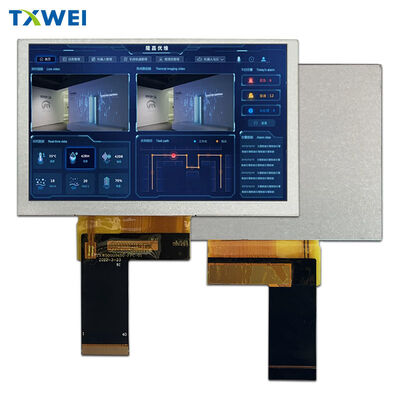
Introducing the TXW500094S6 — an 800×480 TFT LCD module conceived not for the benchtop, but for the field: sunlight, cold chains, engine bays, and machine sheds where the display is the last thing that should fail.
Most display datasheets are written for a temperature-controlled room and an ambient of a few hundred lux. This one is written for the environments equipment actually inhabits. The TXW500094S6 couples an 800×RGB×480 TFT active-matrix panel to a 1500 cd/m² edge-lit backlight, a 24-bit RGB interface driven by the ST7262H, and an operating envelope of -30 °C to +85 °C validated across a 240-hour qualification matrix and 50 thermal-shock cycles. The result is a component whose specification is defined by the worst conditions it will meet, not the best.
Perceived readability is governed by the effective contrast ratio, not by luminance in isolation. Under an ambient illuminance E, a display surface of reflectance ρ reflects a luminance of approximately Lrefl ≈ E·ρ/π. Because this reflected term is additive to both the bright and dark states, the effective contrast collapses as ambient light rises:
Note also that this is supplied as an open panel (TFT + driver + FPC + backlight). The reflectance term is therefore an integration variable: the cover glass, its anti-glare treatment, and the bonding method you choose determine the specular and diffuse reflectance of the finished front surface. Specifying a display in isolation — without accounting for the stack it will live in — is one of the most common causes of an "unreadable" outdoor product that looked adequate on paper.
A 1500 cd/m² front-of-screen luminance is the endpoint of a chain of losses, and understanding the budget explains the design. Light leaves 18 dual-chip white LEDs (two emitting die per package, concentrating flux into fewer, electrically cooler devices), is edge-coupled into a light-guide plate, homogenized by diffusers, and then passes through the liquid-crystal cell — where, as in all transmissive LCDs, the crossed polarizers and color filters absorb the majority of the flux.
The practical consequence: the backlight must emit many times the target on-screen luminance. Reaching 1500 cd/m² at only 120 mA and 16.5-17.4 V (roughly two watts of LED power) reflects the efficiency of the dual-chip, edge-lit architecture. Fewer, better-driven emitters also simplify thermal management — fewer, cooler junctions age more slowly, and less waste heat demands less enclosure volume, which is exactly the currency an industrial enclosure is short on.
Luminous depreciation in white LEDs is a thermally activated process: degradation kinetics accelerate with junction temperature in the Arrhenius form rate ∝ exp(−Ea/kT), where Ea typically falls in the 0.4-0.7 eV range and k is Boltzmann's constant. Rated life is 20,000 hours to 50% luminance at 20 mA per LED, and the datasheet is explicit that the figure degrades above 25 mA per LED — not because current is "bad," but because it raises the junction temperature that drives the very reaction consuming the phosphor and die.
The panel is a normally-black, transmissive TFT active-matrix cell operating in the standard twisted-nematic family with an "all-clock" viewing designation. Each pixel is an independently addressed capacitor-switched element, refreshed row by row; the unpowered state maps to dark, which favors contrast and reduces power in dark-biased interfaces. With 8 bits per primary, the system resolves 16.7 million colors — true 24-bit color, sufficient for professional HMI, charting, and photographic content, and matched to the 24-bit RGB interface so no colour depth is discarded in transport.
At 800×480 across a 5-inch diagonal with a 0.135 mm pixel pitch, density reaches roughly 187 pixels per inch — enough for crisp small text and gauge numerals at typical panel-to-eye distances, without demanding the bandwidth that higher resolutions would impose on a modest host processor. This is a deliberate balance: resolution where it aids legibility, restraint where it costs system complexity.
The module presents the most universally understood display interface: a parallel 24-bit RGB bus (R0-R7, G0-G7, B0-B7), a pixel clock (DCLK), and timing signals that support both DE mode (data-enable) and SYNC mode (HSYNC/VSYNC), selected to match the host graphics pipeline. A DISP control line switches between normal display and standby, and the ST7262H manages panel drive and the on-module DC/DC conversion from a 3.3 V (2.8-3.6 V) supply.
Signal integrity is the integrator's responsibility and the usual source of field problems. Treat the pixel clock as a fast edge: match trace lengths, preserve a continuous reference-ground return beneath the bus, terminate where reflections loom, and keep the display flex clear of switch-mode regulators and motor drives. A 24-bit bus at modest clock rates is forgiving, but not infinitely so — skew between data and clock shows up as colour noise long before total failure.
The qualification program is deliberately harsher than the market norm: 240 hours — ten times a commonplace 24-hour check — at each of high-temperature storage (+85 °C), low-temperature storage (-30 °C), and operating extremes, plus 240 hours at 60 °C/90%RH and 50 cycles of -30 °C↔+85 °C thermal shock. Pass criteria reject the specific failure modes that quietly ruin fielded equipment: missing or shorted segments, display anomalies, clarity loss, seal loosening, bubbles, and liquid-crystal leakage.
These tests matter because reliability is a system property, not a component checkbox. Thermal cycling exercises the seal and the adhesive interfaces; humidity drives ingress; cold soaks reveal LC viscosity limits; heat exposes the LED string's thermal margin. A module that survives all four arrives pre-validated for the assembly, not merely the lab.
| Dimension | This Module | Typical Indoor Panel |
| Front luminance | 1500 cd/m² | ~300-500 cd/m² |
| Ambient legibility | Superior (headroom) | Washes out in sun |
| Operating envelope | -30°C to +85°C | 0°C to +50°C |
| Interface | 24-bit RGB (DE/SYNC) | Often SPI/MIPI only |
| Qualification | 240 h + 50 cycles | 24 h spot checks |
| Colour depth | 16.7M (24-bit) | Often 16-bit/65K |
| Display Size | 5.0 inch |
| Resolution | 800 × RGB × 480 dots (WVGA) |
| Pixel Density | ~187 PPI |
| LCD Type | TFT active matrix, normally black, transmissive |
| Viewing Direction | ALL |
| Driver IC | ST7262H |
| Interface | 24-bit RGB (DE / SYNC mode) |
| Pixel Pitch | 0.135 × 0.135 mm |
| Active Area | 108.00 × 64.80 mm |
| Module Size | 120.70 × 75.80 × 2.80 mm |
| Brightness | 1500 cd/m² (with LCD) |
| Backlight | 18 dual-chip white LEDs, 120 mA, VF 16.5-17.4 V |
| LED Life Time | 20,000 hours |
| Color Depth | 16.7M (8-bit per channel) |
| Supply Voltage (VDD) | 2.8 - 3.6 V (typ. 3.3 V) |
| Operating Temperature | -30°C to +85°C |
| Storage Temperature | -30°C to +85°C |
| Environmental | RoHS compliant, lead-free |
| Test Item | Condition |
| High-Temperature Storage | +85°C / 240 H |
| Low-Temperature Storage | -30°C / 240 H |
| High-Temperature Operating | +85°C / 240 H |
| Low-Temperature Operating | -30°C / 240 H |
| High-Temperature / Humidity Storage | 60°C × 90%RH / 240 H |
| Thermal and Cold Shock | -30°C ↔ +85°C, 50 cycles |
Q. Is 1500 cd/m² overkill?
A. Only in a dark room. In bright ambient the reflected term dominates the black level; luminance headroom is the only way to preserve usable contrast, so the margin earns its keep outdoors.
Q. Which interface and controller?
A. A 24-bit RGB parallel bus with the ST7262H controller, supporting both DE and SYNC timing modes.
Q. Does it include touch or cover glass?
A. It ships as a display-only module (panel + driver + FPC + backlight); touch and cover glass are integration choices you specify.
Q. How is the 20,000-hour figure defined?
A. As time to 50% luminance at 20 mA per LED. Because it depends on junction temperature, actual life improves with good thermal design and reduced drive.
Q. Is OEM/ODM customization available?
A. Yes — FPC layout, backlight brightness, and interface configuration can be tailored to your program.
The TXW500094S6 is available now for sampling and volume programs, with OEM/ODM customization across FPC, backlight brightness, and interface configuration to fit your enclosure and duty cycle.
Request samples and pricing — and tell us your brightest ambient condition; that is where this display earns its place.
|
|
| MOQ: | 1 Piece |
| Price: | USD 12-25 / Piece |
| Standard Packaging: | Anti-static bag with shock-proof foam insert, export-grade corrugated carton |
| Delivery Period: | 3-7 working days for samples, 15-25 days for mass production |
| Payment Method: | T/T,L/C,PayPal,Western Union |
| Supply Capacity: | 50000 Pieces per Month |
Introducing the TXW500094S6 — an 800×480 TFT LCD module conceived not for the benchtop, but for the field: sunlight, cold chains, engine bays, and machine sheds where the display is the last thing that should fail.
Most display datasheets are written for a temperature-controlled room and an ambient of a few hundred lux. This one is written for the environments equipment actually inhabits. The TXW500094S6 couples an 800×RGB×480 TFT active-matrix panel to a 1500 cd/m² edge-lit backlight, a 24-bit RGB interface driven by the ST7262H, and an operating envelope of -30 °C to +85 °C validated across a 240-hour qualification matrix and 50 thermal-shock cycles. The result is a component whose specification is defined by the worst conditions it will meet, not the best.
Perceived readability is governed by the effective contrast ratio, not by luminance in isolation. Under an ambient illuminance E, a display surface of reflectance ρ reflects a luminance of approximately Lrefl ≈ E·ρ/π. Because this reflected term is additive to both the bright and dark states, the effective contrast collapses as ambient light rises:
Note also that this is supplied as an open panel (TFT + driver + FPC + backlight). The reflectance term is therefore an integration variable: the cover glass, its anti-glare treatment, and the bonding method you choose determine the specular and diffuse reflectance of the finished front surface. Specifying a display in isolation — without accounting for the stack it will live in — is one of the most common causes of an "unreadable" outdoor product that looked adequate on paper.
A 1500 cd/m² front-of-screen luminance is the endpoint of a chain of losses, and understanding the budget explains the design. Light leaves 18 dual-chip white LEDs (two emitting die per package, concentrating flux into fewer, electrically cooler devices), is edge-coupled into a light-guide plate, homogenized by diffusers, and then passes through the liquid-crystal cell — where, as in all transmissive LCDs, the crossed polarizers and color filters absorb the majority of the flux.
The practical consequence: the backlight must emit many times the target on-screen luminance. Reaching 1500 cd/m² at only 120 mA and 16.5-17.4 V (roughly two watts of LED power) reflects the efficiency of the dual-chip, edge-lit architecture. Fewer, better-driven emitters also simplify thermal management — fewer, cooler junctions age more slowly, and less waste heat demands less enclosure volume, which is exactly the currency an industrial enclosure is short on.
Luminous depreciation in white LEDs is a thermally activated process: degradation kinetics accelerate with junction temperature in the Arrhenius form rate ∝ exp(−Ea/kT), where Ea typically falls in the 0.4-0.7 eV range and k is Boltzmann's constant. Rated life is 20,000 hours to 50% luminance at 20 mA per LED, and the datasheet is explicit that the figure degrades above 25 mA per LED — not because current is "bad," but because it raises the junction temperature that drives the very reaction consuming the phosphor and die.
The panel is a normally-black, transmissive TFT active-matrix cell operating in the standard twisted-nematic family with an "all-clock" viewing designation. Each pixel is an independently addressed capacitor-switched element, refreshed row by row; the unpowered state maps to dark, which favors contrast and reduces power in dark-biased interfaces. With 8 bits per primary, the system resolves 16.7 million colors — true 24-bit color, sufficient for professional HMI, charting, and photographic content, and matched to the 24-bit RGB interface so no colour depth is discarded in transport.
At 800×480 across a 5-inch diagonal with a 0.135 mm pixel pitch, density reaches roughly 187 pixels per inch — enough for crisp small text and gauge numerals at typical panel-to-eye distances, without demanding the bandwidth that higher resolutions would impose on a modest host processor. This is a deliberate balance: resolution where it aids legibility, restraint where it costs system complexity.
The module presents the most universally understood display interface: a parallel 24-bit RGB bus (R0-R7, G0-G7, B0-B7), a pixel clock (DCLK), and timing signals that support both DE mode (data-enable) and SYNC mode (HSYNC/VSYNC), selected to match the host graphics pipeline. A DISP control line switches between normal display and standby, and the ST7262H manages panel drive and the on-module DC/DC conversion from a 3.3 V (2.8-3.6 V) supply.
Signal integrity is the integrator's responsibility and the usual source of field problems. Treat the pixel clock as a fast edge: match trace lengths, preserve a continuous reference-ground return beneath the bus, terminate where reflections loom, and keep the display flex clear of switch-mode regulators and motor drives. A 24-bit bus at modest clock rates is forgiving, but not infinitely so — skew between data and clock shows up as colour noise long before total failure.
The qualification program is deliberately harsher than the market norm: 240 hours — ten times a commonplace 24-hour check — at each of high-temperature storage (+85 °C), low-temperature storage (-30 °C), and operating extremes, plus 240 hours at 60 °C/90%RH and 50 cycles of -30 °C↔+85 °C thermal shock. Pass criteria reject the specific failure modes that quietly ruin fielded equipment: missing or shorted segments, display anomalies, clarity loss, seal loosening, bubbles, and liquid-crystal leakage.
These tests matter because reliability is a system property, not a component checkbox. Thermal cycling exercises the seal and the adhesive interfaces; humidity drives ingress; cold soaks reveal LC viscosity limits; heat exposes the LED string's thermal margin. A module that survives all four arrives pre-validated for the assembly, not merely the lab.
| Dimension | This Module | Typical Indoor Panel |
| Front luminance | 1500 cd/m² | ~300-500 cd/m² |
| Ambient legibility | Superior (headroom) | Washes out in sun |
| Operating envelope | -30°C to +85°C | 0°C to +50°C |
| Interface | 24-bit RGB (DE/SYNC) | Often SPI/MIPI only |
| Qualification | 240 h + 50 cycles | 24 h spot checks |
| Colour depth | 16.7M (24-bit) | Often 16-bit/65K |
| Display Size | 5.0 inch |
| Resolution | 800 × RGB × 480 dots (WVGA) |
| Pixel Density | ~187 PPI |
| LCD Type | TFT active matrix, normally black, transmissive |
| Viewing Direction | ALL |
| Driver IC | ST7262H |
| Interface | 24-bit RGB (DE / SYNC mode) |
| Pixel Pitch | 0.135 × 0.135 mm |
| Active Area | 108.00 × 64.80 mm |
| Module Size | 120.70 × 75.80 × 2.80 mm |
| Brightness | 1500 cd/m² (with LCD) |
| Backlight | 18 dual-chip white LEDs, 120 mA, VF 16.5-17.4 V |
| LED Life Time | 20,000 hours |
| Color Depth | 16.7M (8-bit per channel) |
| Supply Voltage (VDD) | 2.8 - 3.6 V (typ. 3.3 V) |
| Operating Temperature | -30°C to +85°C |
| Storage Temperature | -30°C to +85°C |
| Environmental | RoHS compliant, lead-free |
| Test Item | Condition |
| High-Temperature Storage | +85°C / 240 H |
| Low-Temperature Storage | -30°C / 240 H |
| High-Temperature Operating | +85°C / 240 H |
| Low-Temperature Operating | -30°C / 240 H |
| High-Temperature / Humidity Storage | 60°C × 90%RH / 240 H |
| Thermal and Cold Shock | -30°C ↔ +85°C, 50 cycles |
Q. Is 1500 cd/m² overkill?
A. Only in a dark room. In bright ambient the reflected term dominates the black level; luminance headroom is the only way to preserve usable contrast, so the margin earns its keep outdoors.
Q. Which interface and controller?
A. A 24-bit RGB parallel bus with the ST7262H controller, supporting both DE and SYNC timing modes.
Q. Does it include touch or cover glass?
A. It ships as a display-only module (panel + driver + FPC + backlight); touch and cover glass are integration choices you specify.
Q. How is the 20,000-hour figure defined?
A. As time to 50% luminance at 20 mA per LED. Because it depends on junction temperature, actual life improves with good thermal design and reduced drive.
Q. Is OEM/ODM customization available?
A. Yes — FPC layout, backlight brightness, and interface configuration can be tailored to your program.
The TXW500094S6 is available now for sampling and volume programs, with OEM/ODM customization across FPC, backlight brightness, and interface configuration to fit your enclosure and duty cycle.
Request samples and pricing — and tell us your brightest ambient condition; that is where this display earns its place.