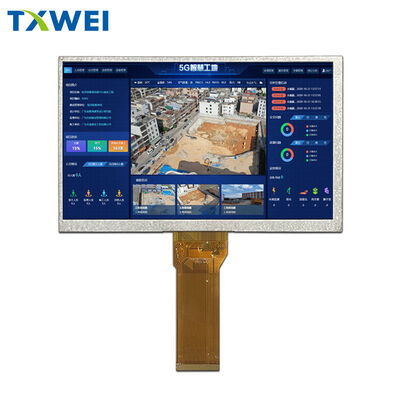
|
|
| MOQ: | 1 Piece (sample order accepted) |
| Price: | Negotiable |
| Standard Packaging: | Anti-static bag with shock-proof foam, export-grade corrugated carton |
| Delivery Period: | 15-25 working days after sample approval |
| Payment Method: | T/T,L/C,D/P |
| Supply Capacity: | 10000 Pieces per Month |
Field Notes / TXW700158K0 / 7.0″ 800 x 480
Every outdoor display project has a moment like this: the first sunny afternoon, the customer standing in front of the unit, and a screen that has quietly become a mirror. The fix is rarely the software. It is almost always the panel, the brightness figure, and whether that figure was a minimum or a hope.
A 7-inch panel sits in an awkward neighbourhood. It is too big to be treated as a component and too small to be treated as a screen. The projects that buy it are almost never consumer products; they are charging stations, weighbridges, vending fascias, workshop boards, medical monitors read from two metres away, and industrial HMI where the buttons are physical and the glass is just there to be looked at. In that company, a touch layer is not a feature. It is a liability with a bill of materials attached.
This module is built for exactly that neighbourhood. 800 by 480 pixels across a 153.84 by 85.63 millimetre active area, 700 candelas per square metre guaranteed as a floor rather than quoted as a typical, a 24-bit parallel RGB bus on a 50-pin tail, and no touch sensor anywhere in the stack. What follows is not a feature list. It is the reasoning behind five decisions, some of which will matter to your project and one or two of which will not — and knowing which is which is the whole point.
Most display specifications quote brightness as a typical value. Typical means the middle of a distribution: half the panels leaving the factory will be dimmer than the number on the page, and your incoming inspection has no contractual grounds to reject them. When a project fails its first sunlight test, the argument that follows is not technical, it is linguistic.
This panel states 700 candelas as a minimum. Every unit that ships meets or exceeds it. That changes what you can promise your own customer, and it changes what your quality team can put in a purchase specification without a footnote. It is also enough output that the panel stays legible outdoors in shade and under workshop strip lighting without a hood, a louvre or an anti-reflective add-on.
The 75 percent uniformity figure deserves the same honesty. Thirty edge LEDs pushing this much light through a light guide is a real optical workload, and 75 percent is what that workload costs. If your interface is text, icons, gauges and coloured panels on a dark ground, you will never see it. If it is a full-bleed white photograph, ask for a uniformity map with the sample before you commit — that is a reasonable request, and the answer will tell you a lot about the supplier.
MIPI became the default in small modules because phones made it so. But the products that buy a 7-inch panel are usually built around an industrial microcontroller — an STM32 with an LCD-TFT controller, a Renesas HMI device. Those controllers speak parallel RGB natively. They do not speak MIPI. Ask them to, and you add a bridge chip that costs more than the panel, eats board area, needs its own firmware layer, and will reach end-of-life before the product it lives inside.
So this module offers 24-bit RGB on a 50-pin tail: eight bits per channel, a pixel clock, a data enable, separate horizontal and vertical syncs, plus MODE, DITHB and reset. It is also the interface you can debug with a logic analyser on a bench at eleven at night, which is when most first articles actually get fixed.
Two pins on that tail deserve more attention than they usually receive: L/R and U/D. They flip the scan direction in hardware. Mount the panel upside down in a ceiling-facing enclosure, rotate the whole product ninety degrees for a portrait variant, or mirror it for a rear-projection style layout, and the image follows two jumper settings instead of a firmware rebuild and a new release cycle. On a project with three enclosure variants, that is a week of engineering nobody has to spend.
Thirty white LEDs at 350 milliamps with a forward voltage of 8.4 to 9.6 volts is roughly three watts of backlight. Three watts does not sound like much until it is sitting inside a sealed polycarbonate box in August. The edge nearest the LED bar will run warmer than the centre, and in a closed enclosure that gradient has nowhere to go but into the panel, where it eventually shows up as a slight colour shift at the corners.
The fix is cheap and early: give the LED edge a thermal path to the housing, keep vents or a metal bracket in the mechanical concept, and avoid putting the power supply directly behind the panel. Do it at the drawing stage and it costs nothing. Discover it at the validation stage and it costs a tooling revision.
If your host is MIPI-only and you cannot add a bridge, this is the wrong part — one of our 5-inch or 3.95-inch modules speaks MIPI natively. If your interface depends on multi-touch gestures on the glass, this is the wrong part — choose a bonded G+G or in-cell design. If 80 percent uniformity is a contractual requirement rather than a preference, say so early and we will propose a different light guide. And if your enclosure is thinner than six millimetres at the panel seat, this module will not fit without a redesign.
Stating exclusions is not modesty. A wrong fit discovered at sample stage costs a project three weeks; discovered in this paragraph it costs nothing.
Customization on this module is deliberately narrow, because without a touch sensor there is no glass print, no window and no touch firmware to negotiate. What can be changed is the FPC length and pinout, the cable assembly, the front treatment — anti-glare film, a different bezel approach — and the brightness option. Reliability qualification covers 96 hours at +80 and at -30 storage, 96 hours operating at +70 and -20, 96 hours at 60 degrees with 90 percent humidity, and ten thermal shock cycles between -20 and +70, with the usual industrial rejection criteria for segments, leakage, bubbling and end seals.
| Ordering reference | |
|---|---|
| Model / brand | TXW700158K0 / TXWEI |
| Origin / certification | Guangdong, China / CE, RoHS, FCC |
| MOQ / price | Sample order accepted; quoted against annual volume |
| Payment / capacity | T/T, L/C, D/P / 10,000 pcs per month |
| Delivery / packing | 15 - 25 working days after approval; anti-static bag, foam, export carton |
Tell us what the product has to survive.
Sunlight, weather, distance, gloved hands or none at all — send the conditions and the enclosure outline, and a matched drawing, front-treatment proposal and quotation follow within one working day.
TXW700158K0 · TXWEI · Shenzhen, Guangdong, China · RoHS compliant
|
|
| MOQ: | 1 Piece (sample order accepted) |
| Price: | Negotiable |
| Standard Packaging: | Anti-static bag with shock-proof foam, export-grade corrugated carton |
| Delivery Period: | 15-25 working days after sample approval |
| Payment Method: | T/T,L/C,D/P |
| Supply Capacity: | 10000 Pieces per Month |
Field Notes / TXW700158K0 / 7.0″ 800 x 480
Every outdoor display project has a moment like this: the first sunny afternoon, the customer standing in front of the unit, and a screen that has quietly become a mirror. The fix is rarely the software. It is almost always the panel, the brightness figure, and whether that figure was a minimum or a hope.
A 7-inch panel sits in an awkward neighbourhood. It is too big to be treated as a component and too small to be treated as a screen. The projects that buy it are almost never consumer products; they are charging stations, weighbridges, vending fascias, workshop boards, medical monitors read from two metres away, and industrial HMI where the buttons are physical and the glass is just there to be looked at. In that company, a touch layer is not a feature. It is a liability with a bill of materials attached.
This module is built for exactly that neighbourhood. 800 by 480 pixels across a 153.84 by 85.63 millimetre active area, 700 candelas per square metre guaranteed as a floor rather than quoted as a typical, a 24-bit parallel RGB bus on a 50-pin tail, and no touch sensor anywhere in the stack. What follows is not a feature list. It is the reasoning behind five decisions, some of which will matter to your project and one or two of which will not — and knowing which is which is the whole point.
Most display specifications quote brightness as a typical value. Typical means the middle of a distribution: half the panels leaving the factory will be dimmer than the number on the page, and your incoming inspection has no contractual grounds to reject them. When a project fails its first sunlight test, the argument that follows is not technical, it is linguistic.
This panel states 700 candelas as a minimum. Every unit that ships meets or exceeds it. That changes what you can promise your own customer, and it changes what your quality team can put in a purchase specification without a footnote. It is also enough output that the panel stays legible outdoors in shade and under workshop strip lighting without a hood, a louvre or an anti-reflective add-on.
The 75 percent uniformity figure deserves the same honesty. Thirty edge LEDs pushing this much light through a light guide is a real optical workload, and 75 percent is what that workload costs. If your interface is text, icons, gauges and coloured panels on a dark ground, you will never see it. If it is a full-bleed white photograph, ask for a uniformity map with the sample before you commit — that is a reasonable request, and the answer will tell you a lot about the supplier.
MIPI became the default in small modules because phones made it so. But the products that buy a 7-inch panel are usually built around an industrial microcontroller — an STM32 with an LCD-TFT controller, a Renesas HMI device. Those controllers speak parallel RGB natively. They do not speak MIPI. Ask them to, and you add a bridge chip that costs more than the panel, eats board area, needs its own firmware layer, and will reach end-of-life before the product it lives inside.
So this module offers 24-bit RGB on a 50-pin tail: eight bits per channel, a pixel clock, a data enable, separate horizontal and vertical syncs, plus MODE, DITHB and reset. It is also the interface you can debug with a logic analyser on a bench at eleven at night, which is when most first articles actually get fixed.
Two pins on that tail deserve more attention than they usually receive: L/R and U/D. They flip the scan direction in hardware. Mount the panel upside down in a ceiling-facing enclosure, rotate the whole product ninety degrees for a portrait variant, or mirror it for a rear-projection style layout, and the image follows two jumper settings instead of a firmware rebuild and a new release cycle. On a project with three enclosure variants, that is a week of engineering nobody has to spend.
Thirty white LEDs at 350 milliamps with a forward voltage of 8.4 to 9.6 volts is roughly three watts of backlight. Three watts does not sound like much until it is sitting inside a sealed polycarbonate box in August. The edge nearest the LED bar will run warmer than the centre, and in a closed enclosure that gradient has nowhere to go but into the panel, where it eventually shows up as a slight colour shift at the corners.
The fix is cheap and early: give the LED edge a thermal path to the housing, keep vents or a metal bracket in the mechanical concept, and avoid putting the power supply directly behind the panel. Do it at the drawing stage and it costs nothing. Discover it at the validation stage and it costs a tooling revision.
If your host is MIPI-only and you cannot add a bridge, this is the wrong part — one of our 5-inch or 3.95-inch modules speaks MIPI natively. If your interface depends on multi-touch gestures on the glass, this is the wrong part — choose a bonded G+G or in-cell design. If 80 percent uniformity is a contractual requirement rather than a preference, say so early and we will propose a different light guide. And if your enclosure is thinner than six millimetres at the panel seat, this module will not fit without a redesign.
Stating exclusions is not modesty. A wrong fit discovered at sample stage costs a project three weeks; discovered in this paragraph it costs nothing.
Customization on this module is deliberately narrow, because without a touch sensor there is no glass print, no window and no touch firmware to negotiate. What can be changed is the FPC length and pinout, the cable assembly, the front treatment — anti-glare film, a different bezel approach — and the brightness option. Reliability qualification covers 96 hours at +80 and at -30 storage, 96 hours operating at +70 and -20, 96 hours at 60 degrees with 90 percent humidity, and ten thermal shock cycles between -20 and +70, with the usual industrial rejection criteria for segments, leakage, bubbling and end seals.
| Ordering reference | |
|---|---|
| Model / brand | TXW700158K0 / TXWEI |
| Origin / certification | Guangdong, China / CE, RoHS, FCC |
| MOQ / price | Sample order accepted; quoted against annual volume |
| Payment / capacity | T/T, L/C, D/P / 10,000 pcs per month |
| Delivery / packing | 15 - 25 working days after approval; anti-static bag, foam, export carton |
Tell us what the product has to survive.
Sunlight, weather, distance, gloved hands or none at all — send the conditions and the enclosure outline, and a matched drawing, front-treatment proposal and quotation follow within one working day.
TXW700158K0 · TXWEI · Shenzhen, Guangdong, China · RoHS compliant