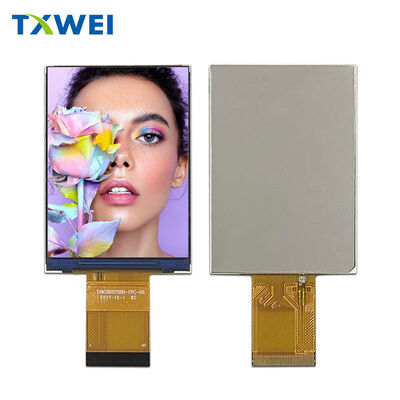
|
|
| MOQ: | Sample order accepted, 100 pcs |
| Price: | Negotiable |
| Standard Packaging: | Anti-static bag, foam, export carton |
| Delivery Period: | 15-25 working days after sample approval |
| Payment Method: | T/T,L/C,D/P |
| Supply Capacity: | 10,000 pcs per month |
There is a category of product that never appears in display marketing: the handheld instrument. A gas detector, a portable meter, a patient monitor on a rolling stand, a field terminal clipped to a belt. These devices sell on reliability and on the shape of their screen — tall, narrow, read while held in one hand — and most of them are built around a microcontroller costing two dollars. For that customer, the interesting question is never how many colours the panel can produce. It is whether the thing can be lit up without adding a second chip.
This module answers that question. Everything below is a design note on four decisions, plus a short list of the things this panel deliberately does not do.
Ask ten engineers who build portable instruments what they want from a display and nine will describe the same object: something that fits a pocket that was designed three years ago, draws little enough that the battery is not the limiting factor, and lights up on the first afternoon without a week of driver archaeology. The tenth will ask for sunlight legibility, and will be told, politely, that this is a different product at a different price.
What makes the handheld case interesting is that it is one of the few places in the display business where a smaller number is genuinely better. Fewer bits on the bus means fewer traces on a four-layer board. One power rail for the logic means one less sequencing dependency at power-up. No touch layer means no bonding tolerance, no window print and no calibration step on the line. Each of those is a cost that does not appear on a quotation but does appear in a project schedule, and the schedule is usually the thing that actually runs out.
A 480 by 640 panel is not a landscape screen turned sideways. On a 43.20 by 57.60 millimetre active area, the extra 160 rows are what let a menu hold eight lines instead of five, or a numeric field sit above a soft key without the two competing for space. With a 0.090 millimetre pixel pitch, text at 12 to 14 pixel cap height stays crisp at reading distance — which is the distance a hand-held device is actually used at, not the metre and a half of a wall display.
The GC9503V is driven over a 16-bit RGB bus: VSYNC, HSYNC, PCLK and DE as synchronisation, and sixteen data lines carrying the colour. That is the interface an LCD-TFT peripheral on an industrial MCU produces natively — no DSI channel, no bridge chip, no second power rail to sequence. Register access goes over a separate three-wire serial port — CS, SCL, SDA — so initialisation lives on a normal GPIO bit-bang or a hardware SPI block, and the panel is running before the main loop starts.
The practical consequence shows up on the bench. A parallel RGB panel is debugged with a scope on four wires: if the clock runs and the syncs agree, the picture appears, and if it does not, the fault is in the timing table rather than in a protocol handshake you cannot see. That is why this interface survives in industrial design long after consumer electronics abandoned it — not because it is elegant, but because it fails in ways a single engineer can diagnose at eleven at night.
The outline is 46.90 by 66.55 millimetres and 2.40 millimetres thick, which places it within a hair of the 2.8-inch modules that have populated handheld housings for a decade. Where the pocket in the moulding has room, a project can gain 160 rows of vertical resolution without retooling the front case — the mechanical work narrows to the gasket and the flex exit. There is no touch sensor in the stack, so there is no bonded layer to gap, no window dimension to negotiate and no touch firmware to integrate.
320 candelas typical with 80 percent minimum uniformity, from six white LEDs running at 20 milliamps on a 16.8 to 19.2 volt string. That is a modest backlight, and it is the right size for a clinic room, a laboratory bench or a service counter. Viewed from any clock position — the panel is specified with a free viewing direction — the image holds its contrast when the device is tilted toward a second person. Rated life at that drive current is 30,000 hours, with the familiar caveat that pushing past 25 milliamps shortens it.
Four trade-offs were made deliberately. They are recorded here because a specification sheet that hides them is harder to design with than one that states them.
| Item | Choice | Reason |
|---|---|---|
| Interface | 16-bit RGB, not MIPI | Keeps industrial MCU designs free of a bridge chip |
| Colour depth | 16 bit per pixel | Instrument UI needs legibility, not photographic gradient |
| Touch | Left to the customer | Many of these devices use physical keys, sealed and gloved |
| Brightness | 320 cd/m² typical | Indoor grade, matched to the battery budget of a portable device |
Writing that list is uncomfortable, and it is also the most useful page in this note. Most sourcing problems do not begin with a part that is too expensive; they begin with a part that was described as more than it is, discovered at the validation stage, and replaced too late for the tooling to change. A panel that states its ceiling lets a project plan around it — an outdoor variant, a second model, a different enclosure — while there is still time on the calendar to do something about it.
Qualification follows the standard industrial sequence: 96 hours at +70 °C and at -30 °C storage, 96 hours operating at +60 °C and at -20 °C, 96 hours at 50 °C with 90 percent relative humidity, and 50 thermal cycles between -20 and +70 °C. Acceptance follows normal criteria for missing segments, shorts, leakage, low-temperature bubbles and end-seal integrity.
There is one more argument for a portrait format that rarely makes it into a specification discussion. A handheld is held in one hand and operated with the other, so the eye sits closer to the top of the screen than the bottom, and the thumb reaches the lower third. A tall canvas lets the reading zone and the control zone occupy different parts of the glass instead of overlapping them — which is the difference between a device that is merely usable and one whose interface feels considered.
Send the housing outline, not the wish list.
The useful starting point for a 2.83-inch design is the pocket depth, the viewing distance and the controller you are already committed to. With those three, a matched drawing, front-treatment proposal and quotation follow within one working day.
TXW280075B0 · TXWEI · Shenzhen, Guangdong, China · RoHS compliant
|
|
| MOQ: | Sample order accepted, 100 pcs |
| Price: | Negotiable |
| Standard Packaging: | Anti-static bag, foam, export carton |
| Delivery Period: | 15-25 working days after sample approval |
| Payment Method: | T/T,L/C,D/P |
| Supply Capacity: | 10,000 pcs per month |
There is a category of product that never appears in display marketing: the handheld instrument. A gas detector, a portable meter, a patient monitor on a rolling stand, a field terminal clipped to a belt. These devices sell on reliability and on the shape of their screen — tall, narrow, read while held in one hand — and most of them are built around a microcontroller costing two dollars. For that customer, the interesting question is never how many colours the panel can produce. It is whether the thing can be lit up without adding a second chip.
This module answers that question. Everything below is a design note on four decisions, plus a short list of the things this panel deliberately does not do.
Ask ten engineers who build portable instruments what they want from a display and nine will describe the same object: something that fits a pocket that was designed three years ago, draws little enough that the battery is not the limiting factor, and lights up on the first afternoon without a week of driver archaeology. The tenth will ask for sunlight legibility, and will be told, politely, that this is a different product at a different price.
What makes the handheld case interesting is that it is one of the few places in the display business where a smaller number is genuinely better. Fewer bits on the bus means fewer traces on a four-layer board. One power rail for the logic means one less sequencing dependency at power-up. No touch layer means no bonding tolerance, no window print and no calibration step on the line. Each of those is a cost that does not appear on a quotation but does appear in a project schedule, and the schedule is usually the thing that actually runs out.
A 480 by 640 panel is not a landscape screen turned sideways. On a 43.20 by 57.60 millimetre active area, the extra 160 rows are what let a menu hold eight lines instead of five, or a numeric field sit above a soft key without the two competing for space. With a 0.090 millimetre pixel pitch, text at 12 to 14 pixel cap height stays crisp at reading distance — which is the distance a hand-held device is actually used at, not the metre and a half of a wall display.
The GC9503V is driven over a 16-bit RGB bus: VSYNC, HSYNC, PCLK and DE as synchronisation, and sixteen data lines carrying the colour. That is the interface an LCD-TFT peripheral on an industrial MCU produces natively — no DSI channel, no bridge chip, no second power rail to sequence. Register access goes over a separate three-wire serial port — CS, SCL, SDA — so initialisation lives on a normal GPIO bit-bang or a hardware SPI block, and the panel is running before the main loop starts.
The practical consequence shows up on the bench. A parallel RGB panel is debugged with a scope on four wires: if the clock runs and the syncs agree, the picture appears, and if it does not, the fault is in the timing table rather than in a protocol handshake you cannot see. That is why this interface survives in industrial design long after consumer electronics abandoned it — not because it is elegant, but because it fails in ways a single engineer can diagnose at eleven at night.
The outline is 46.90 by 66.55 millimetres and 2.40 millimetres thick, which places it within a hair of the 2.8-inch modules that have populated handheld housings for a decade. Where the pocket in the moulding has room, a project can gain 160 rows of vertical resolution without retooling the front case — the mechanical work narrows to the gasket and the flex exit. There is no touch sensor in the stack, so there is no bonded layer to gap, no window dimension to negotiate and no touch firmware to integrate.
320 candelas typical with 80 percent minimum uniformity, from six white LEDs running at 20 milliamps on a 16.8 to 19.2 volt string. That is a modest backlight, and it is the right size for a clinic room, a laboratory bench or a service counter. Viewed from any clock position — the panel is specified with a free viewing direction — the image holds its contrast when the device is tilted toward a second person. Rated life at that drive current is 30,000 hours, with the familiar caveat that pushing past 25 milliamps shortens it.
Four trade-offs were made deliberately. They are recorded here because a specification sheet that hides them is harder to design with than one that states them.
| Item | Choice | Reason |
|---|---|---|
| Interface | 16-bit RGB, not MIPI | Keeps industrial MCU designs free of a bridge chip |
| Colour depth | 16 bit per pixel | Instrument UI needs legibility, not photographic gradient |
| Touch | Left to the customer | Many of these devices use physical keys, sealed and gloved |
| Brightness | 320 cd/m² typical | Indoor grade, matched to the battery budget of a portable device |
Writing that list is uncomfortable, and it is also the most useful page in this note. Most sourcing problems do not begin with a part that is too expensive; they begin with a part that was described as more than it is, discovered at the validation stage, and replaced too late for the tooling to change. A panel that states its ceiling lets a project plan around it — an outdoor variant, a second model, a different enclosure — while there is still time on the calendar to do something about it.
Qualification follows the standard industrial sequence: 96 hours at +70 °C and at -30 °C storage, 96 hours operating at +60 °C and at -20 °C, 96 hours at 50 °C with 90 percent relative humidity, and 50 thermal cycles between -20 and +70 °C. Acceptance follows normal criteria for missing segments, shorts, leakage, low-temperature bubbles and end-seal integrity.
There is one more argument for a portrait format that rarely makes it into a specification discussion. A handheld is held in one hand and operated with the other, so the eye sits closer to the top of the screen than the bottom, and the thumb reaches the lower third. A tall canvas lets the reading zone and the control zone occupy different parts of the glass instead of overlapping them — which is the difference between a device that is merely usable and one whose interface feels considered.
Send the housing outline, not the wish list.
The useful starting point for a 2.83-inch design is the pocket depth, the viewing distance and the controller you are already committed to. With those three, a matched drawing, front-treatment proposal and quotation follow within one working day.
TXW280075B0 · TXWEI · Shenzhen, Guangdong, China · RoHS compliant