logo
Products
PRODUCTS DETAILS
Home > Products >
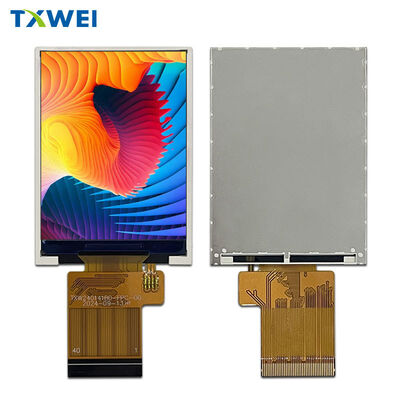
2.4 Inch 240x320 TFT LCD Module 450 nits 3-Line SPI 18-Bit RGB Dual Interface 40 Pin

2.4 Inch 240x320 TFT LCD Module 450 nits 3-Line SPI 18-Bit RGB Dual Interface 40 Pin

MOQ: Sample order accepted, 100 pcs
Price: Negotiable
Standard Packaging: Anti-static bag, foam, export carton
Delivery Period: 15-25 working days after sample approval
Payment Method: T/T,L/C,D/P
Supply Capacity: 10,000 pcs per month
Detail Information
Place of Origin
Guangdong, China
Brand Name
TXWEI
Certification
CE, RoHS, FCC
Model Number
TXW240141B0
Size:
2.4 Inch
Resolution:
240 X RGB X 320 Dots
Display Type:
TFT, Transmissive, Normally Black
Driver IC:
Sitronix ST7789V2
Interface:
3-line SPI Or 18-bit RGB, 40-pin FPC
Pixel Pitch:
0.153 X 0.153 Mm
Active Area:
36.72 X 48.96 Mm
Outline Size:
42.72 X 60.26 X 2.20 Mm
Viewing Direction:
All Clock
Brightness:
450 Cd/m2 Typical
Uniformity:
80% Minimum
Colors:
65K / 262K Selectable
Backlight:
4 White LEDs, 80 MA, 2.8-3.2 V, 30,000 Hours
I/O Voltage:
IOVCC 1.65-3.3 V, VCC 2.5-3.3 V
Operating Temperature:
-20 To +70 C
Storage Temperature:
-30 To +70 C
Touch:
None
Highlight:

2.4 Inch TFT LCD Module

,

240x320 TFT LCD 450 nits

,

3-Line SPI TFT LCD 40 Pin

Product Description
TXW240141B0  /  2.4″ 240 x 320
One Panel, Two Personalities
Three wires if your microcontroller is small. Twenty-seven wires if your frame rate matters. The same glass, the same backlight, decided at the connector.
Mode A
3-Line SPI
Serial clock, chip select, data in
Mode B
18-Bit RGB
Parallel bus, clock, both syncs, DE

Small panels are the hardest part of a display range to choose, and the reason is never optical. It is arithmetic. On a 2.4-inch product the display is maybe a fifth of the bill of materials, while the components that surround it — the boost converter, the level shifter, the bridge chip, the connector with enough pins — can quietly add more than the panel itself. Engineers who have shipped a handful of these devices stop choosing panels by datasheet brightness and start choosing them by what they will not have to design around.

This module was laid out for that way of choosing. It is a 2.4-inch, 240 by 320 IPS-type panel on a Sitronix ST7789V2, with two interface personalities wired to the same 40-pin tail: a three-wire serial port for microcontrollers that have almost nothing to spare, and an 18-bit parallel RGB bus for designs that need a full frame rate and a 262K colour palette. Neither is a compromise mode. Both are specified, both are documented in the timing package, and the choice belongs to the project rather than the purchase order.

Brightness
450 cd/m²
Module thickness
2.20 mm
Backlight string
2.8 - 3.2 V
Colour depth
65K / 262K

The three-wire route, and what it actually buys

In serial mode the panel is addressed over SCL, CS and SDI — clock, select, data — with the ninth bit of each transfer telling the controller whether the byte that follows is a command or a pixel. Three wires and two power pins take the place of a parallel bus, which is what makes the mode interesting: a small MCU with no LCD peripheral at all, or a design that already ran out of GPIO, can still drive a colour display without changing the host.

The trade is speed, and it is a real trade rather than a footnote. Serial transfers take time in proportion to the number of pixels, so a full-screen refresh arrives as a visible sweep rather than a frame. That is entirely acceptable for the interfaces these devices actually run — a menu, a set-point, a numeric readout that changes once a second — and it is the wrong choice for anything that scrolls, animates or plays back. Knowing which of the two your product is, before the PCB is laid out, is the entire decision.

The other personality: 18-bit parallel

Switch to the RGB bus and the same panel becomes a conventional display: R0 to R5, G0 to G5 and B0 to B5 carrying six bits per channel, with PCLK, HSYNC, VSYNC and DE providing timing. Eighteen bits gives 262,144 colours, the panel accepts a 65K mode as well, and the refresh becomes continuous rather than painted. Any controller with an LCD-TFT peripheral — the STM32 family,  Renesas HMI devices — drives it with the hardware it already has.

In practice 3-Line SPI 18-Bit RGB
Signal count 3 plus power 22 plus power
Host requirement Any SPI block or bit-banged pins LCD-TFT peripheral with frame buffer
Refresh behaviour Progressive write, visible sweep Continuous frame, tear-free when synced
Colour 65K or 262K depending on mode 262K, six bits per channel
Best fit Meters, controllers, status panels Wearables with animation, GUI devices

Three components this panel lets you delete

The most useful figure on this datasheet is not the brightness. It is the backlight string: four white LEDs with a forward voltage of 2.8 to 3.2 volts at 80 milliamps, which means a single 3.3 volt rail can light it through a current-limiting element. No boost converter, no inductor, no switching node to lay out and no soft-start to sequence. On a small board where the boost circuit would have occupied the last available corner, that is the difference between a two-layer design and a four-layer one.

No boost converter
A 3 volt string runs from the logic rail; the schematic keeps a resistor or a linear sink instead of a switching supply.
No bridge chip
The ST7789V2 speaks both a serial and a parallel dialect, so the interface changes with firmware, not with a BOM line.
No second connector
One 40-pin tail carries display signals, the separate 1.8 volt I/O rail and the backlight, in one actuation on the line.

450 nits on a small screen is not the same as 450 nits on a large one

Brightness scales with area in a way that is easy to misjudge. Forty-five hundredths of a square metre of glass at 450 candelas reads comfortably in a lit room and stays usable in a workshop, because the eye is close and the angular size is small; the same figure on a seven-inch panel would look dim at two metres. Uniformity is 80 percent minimum across 36.72 by 48.96 millimetres, which on a display of this size is visually generous — the diagonal is under three inches, and the light guide has very little distance over which to fall off.

The panel is specified for -20 to +70 degrees operating and -30 to +70 storage, a wider window than most of our compact modules and one that matters for devices left on a dashboard or carried between a cold store and a warm office. Colour is selectable at 65K or 262K in software, which is a genuine convenience: a legacy host that can only push sixteen bits does not need to be redesigned to use this panel.

What this panel will not do

Two hundred and forty by three hundred and twenty is a numeric interface, not a photographic one. At 0.153 millimetres per pixel the dot structure is visible at reading distance if you look for it, which is why this part belongs in instruments, not in consumer products that display imagery. There is no touch sensor in the stack and no touch option on this build; products that need a touch surface should start from a bonded module. And the module is 2.20 millimetres thick with a stiffener on the flex — a genuinely thin part, but one that expects a mechanical seat rather than a floating mounting.

None of that is a defect. It is the shape of the product, stated before you design around it.

Qualification, customization and delivery

Reliability follows the industrial sequence used across the range: 96 hours storage at +70 and at -30, 96 hours operating at +70 and at -20, 96 hours at 50 degrees and 90 percent relative humidity, and ten thermal shock cycles between -20 and +60. Acceptance applies the usual criteria for missing segments, shorts, leakage, low-temperature bubbles and end-seal integrity.

Ordering path  ·  samples with full timing and initialisation notes for both interface modes  ·  customization on FPC length, pinout and cable assembly, front film treatment and brightness upgrade  ·  15 to 25 working days after sample approval  ·  10,000 pieces per month  ·  anti-static bag, foam and export carton.

Three questions, answered plainly

Can I switch modes in the same product?
Not on a populated board — the pins are shared, so the routing differs. The choice is a layout decision, and the datasheet supports either.
Does the 1.8 volt I/O rail have to be 1.8?
IOVCC is specified from 1.65 to 3.3 volts, so a 3.3 volt host can drive it directly while VCC stays at 3.3.
How much current does the backlight draw?
80 milliamps at 2.8 to 3.2 volts — under a quarter of a watt, which is why it can be run from the logic rail without a switcher.

Tell us which mode your board was laid out for.

Send the host part number and the pin budget, and what comes back is a drawing, an initialisation note for that specific mode, and a quotation.

TXW240141B0  ·  TXWEI  ·  Shenzhen, Guangdong, China  ·  RoHS compliant

Products
PRODUCTS DETAILS
2.4 Inch 240x320 TFT LCD Module 450 nits 3-Line SPI 18-Bit RGB Dual Interface 40 Pin
MOQ: Sample order accepted, 100 pcs
Price: Negotiable
Standard Packaging: Anti-static bag, foam, export carton
Delivery Period: 15-25 working days after sample approval
Payment Method: T/T,L/C,D/P
Supply Capacity: 10,000 pcs per month
Detail Information
Place of Origin
Guangdong, China
Brand Name
TXWEI
Certification
CE, RoHS, FCC
Model Number
TXW240141B0
Size:
2.4 Inch
Resolution:
240 X RGB X 320 Dots
Display Type:
TFT, Transmissive, Normally Black
Driver IC:
Sitronix ST7789V2
Interface:
3-line SPI Or 18-bit RGB, 40-pin FPC
Pixel Pitch:
0.153 X 0.153 Mm
Active Area:
36.72 X 48.96 Mm
Outline Size:
42.72 X 60.26 X 2.20 Mm
Viewing Direction:
All Clock
Brightness:
450 Cd/m2 Typical
Uniformity:
80% Minimum
Colors:
65K / 262K Selectable
Backlight:
4 White LEDs, 80 MA, 2.8-3.2 V, 30,000 Hours
I/O Voltage:
IOVCC 1.65-3.3 V, VCC 2.5-3.3 V
Operating Temperature:
-20 To +70 C
Storage Temperature:
-30 To +70 C
Touch:
None
Minimum Order Quantity:
Sample order accepted, 100 pcs
Price:
Negotiable
Packaging Details:
Anti-static bag, foam, export carton
Delivery Time:
15-25 working days after sample approval
Payment Terms:
T/T,L/C,D/P
Supply Ability:
10,000 pcs per month
Highlight

2.4 Inch TFT LCD Module

,

240x320 TFT LCD 450 nits

,

3-Line SPI TFT LCD 40 Pin

Product Description
TXW240141B0  /  2.4″ 240 x 320
One Panel, Two Personalities
Three wires if your microcontroller is small. Twenty-seven wires if your frame rate matters. The same glass, the same backlight, decided at the connector.
Mode A
3-Line SPI
Serial clock, chip select, data in
Mode B
18-Bit RGB
Parallel bus, clock, both syncs, DE

Small panels are the hardest part of a display range to choose, and the reason is never optical. It is arithmetic. On a 2.4-inch product the display is maybe a fifth of the bill of materials, while the components that surround it — the boost converter, the level shifter, the bridge chip, the connector with enough pins — can quietly add more than the panel itself. Engineers who have shipped a handful of these devices stop choosing panels by datasheet brightness and start choosing them by what they will not have to design around.

This module was laid out for that way of choosing. It is a 2.4-inch, 240 by 320 IPS-type panel on a Sitronix ST7789V2, with two interface personalities wired to the same 40-pin tail: a three-wire serial port for microcontrollers that have almost nothing to spare, and an 18-bit parallel RGB bus for designs that need a full frame rate and a 262K colour palette. Neither is a compromise mode. Both are specified, both are documented in the timing package, and the choice belongs to the project rather than the purchase order.

Brightness
450 cd/m²
Module thickness
2.20 mm
Backlight string
2.8 - 3.2 V
Colour depth
65K / 262K

The three-wire route, and what it actually buys

In serial mode the panel is addressed over SCL, CS and SDI — clock, select, data — with the ninth bit of each transfer telling the controller whether the byte that follows is a command or a pixel. Three wires and two power pins take the place of a parallel bus, which is what makes the mode interesting: a small MCU with no LCD peripheral at all, or a design that already ran out of GPIO, can still drive a colour display without changing the host.

The trade is speed, and it is a real trade rather than a footnote. Serial transfers take time in proportion to the number of pixels, so a full-screen refresh arrives as a visible sweep rather than a frame. That is entirely acceptable for the interfaces these devices actually run — a menu, a set-point, a numeric readout that changes once a second — and it is the wrong choice for anything that scrolls, animates or plays back. Knowing which of the two your product is, before the PCB is laid out, is the entire decision.

The other personality: 18-bit parallel

Switch to the RGB bus and the same panel becomes a conventional display: R0 to R5, G0 to G5 and B0 to B5 carrying six bits per channel, with PCLK, HSYNC, VSYNC and DE providing timing. Eighteen bits gives 262,144 colours, the panel accepts a 65K mode as well, and the refresh becomes continuous rather than painted. Any controller with an LCD-TFT peripheral — the STM32 family,  Renesas HMI devices — drives it with the hardware it already has.

In practice 3-Line SPI 18-Bit RGB
Signal count 3 plus power 22 plus power
Host requirement Any SPI block or bit-banged pins LCD-TFT peripheral with frame buffer
Refresh behaviour Progressive write, visible sweep Continuous frame, tear-free when synced
Colour 65K or 262K depending on mode 262K, six bits per channel
Best fit Meters, controllers, status panels Wearables with animation, GUI devices

Three components this panel lets you delete

The most useful figure on this datasheet is not the brightness. It is the backlight string: four white LEDs with a forward voltage of 2.8 to 3.2 volts at 80 milliamps, which means a single 3.3 volt rail can light it through a current-limiting element. No boost converter, no inductor, no switching node to lay out and no soft-start to sequence. On a small board where the boost circuit would have occupied the last available corner, that is the difference between a two-layer design and a four-layer one.

No boost converter
A 3 volt string runs from the logic rail; the schematic keeps a resistor or a linear sink instead of a switching supply.
No bridge chip
The ST7789V2 speaks both a serial and a parallel dialect, so the interface changes with firmware, not with a BOM line.
No second connector
One 40-pin tail carries display signals, the separate 1.8 volt I/O rail and the backlight, in one actuation on the line.

450 nits on a small screen is not the same as 450 nits on a large one

Brightness scales with area in a way that is easy to misjudge. Forty-five hundredths of a square metre of glass at 450 candelas reads comfortably in a lit room and stays usable in a workshop, because the eye is close and the angular size is small; the same figure on a seven-inch panel would look dim at two metres. Uniformity is 80 percent minimum across 36.72 by 48.96 millimetres, which on a display of this size is visually generous — the diagonal is under three inches, and the light guide has very little distance over which to fall off.

The panel is specified for -20 to +70 degrees operating and -30 to +70 storage, a wider window than most of our compact modules and one that matters for devices left on a dashboard or carried between a cold store and a warm office. Colour is selectable at 65K or 262K in software, which is a genuine convenience: a legacy host that can only push sixteen bits does not need to be redesigned to use this panel.

What this panel will not do

Two hundred and forty by three hundred and twenty is a numeric interface, not a photographic one. At 0.153 millimetres per pixel the dot structure is visible at reading distance if you look for it, which is why this part belongs in instruments, not in consumer products that display imagery. There is no touch sensor in the stack and no touch option on this build; products that need a touch surface should start from a bonded module. And the module is 2.20 millimetres thick with a stiffener on the flex — a genuinely thin part, but one that expects a mechanical seat rather than a floating mounting.

None of that is a defect. It is the shape of the product, stated before you design around it.

Qualification, customization and delivery

Reliability follows the industrial sequence used across the range: 96 hours storage at +70 and at -30, 96 hours operating at +70 and at -20, 96 hours at 50 degrees and 90 percent relative humidity, and ten thermal shock cycles between -20 and +60. Acceptance applies the usual criteria for missing segments, shorts, leakage, low-temperature bubbles and end-seal integrity.

Ordering path  ·  samples with full timing and initialisation notes for both interface modes  ·  customization on FPC length, pinout and cable assembly, front film treatment and brightness upgrade  ·  15 to 25 working days after sample approval  ·  10,000 pieces per month  ·  anti-static bag, foam and export carton.

Three questions, answered plainly

Can I switch modes in the same product?
Not on a populated board — the pins are shared, so the routing differs. The choice is a layout decision, and the datasheet supports either.
Does the 1.8 volt I/O rail have to be 1.8?
IOVCC is specified from 1.65 to 3.3 volts, so a 3.3 volt host can drive it directly while VCC stays at 3.3.
How much current does the backlight draw?
80 milliamps at 2.8 to 3.2 volts — under a quarter of a watt, which is why it can be run from the logic rail without a switcher.

Tell us which mode your board was laid out for.

Send the host part number and the pin budget, and what comes back is a drawing, an initialisation note for that specific mode, and a quotation.

TXW240141B0  ·  TXWEI  ·  Shenzhen, Guangdong, China  ·  RoHS compliant

sitemap |  Privacy Policy | China Good Quality TFT LCD Display Supplier. Copyright © 2024-2026 Shenzhen Tianxianwei Technology Co., Ltd. . All Rights Reserved.