|
|
| MOQ: | 10 Pieces |
| Price: | Negotiable by specification and volume |
| Standard Packaging: | Anti-static tray with protective film, ESD bag, shock-proof foam, export-grade corrugated carton |
| Delivery Period: | 3-5 working days for stock, 20-25 days for mass production |
| Payment Method: | T/T |
| Supply Capacity: | 50000 Pieces per Month |
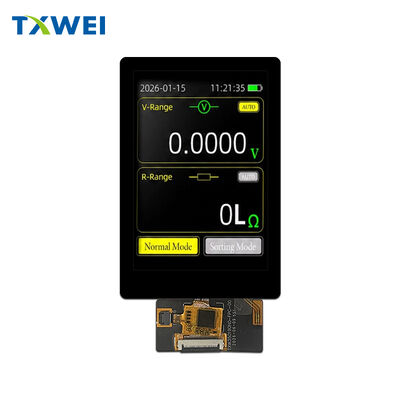
320 × 480 dots, ST7365P driver, one-lane MIPI, G+F+F touch on GT911, 2.20 mm panel and 3.93 mm with touch.
This module is a selection decision more than a specification. A 3.5 inch handheld or wall-mounted product normally needs a display, a touch layer, a backlight driver and a connector for each; the bill of materials, the assembly drawing and the test plan all grow from that. Here the four arrive as one part with one 24-pin tail, and the job becomes checking that the numbers fit the housing.
Six checks before you commitSingle-lane MIPI at 320 × 480 is comfortable for control interfaces and slow animation, and marginal for video. If the product plays full-frame video, plan the data rate before choosing the panel, not after.
The LCM is 54.48 × 84.71 × 2.20 mm; adding the G+F+F touch stack brings it to 57.60 × 87.73 × 3.93 mm. That 1.73 mm difference is the touch layer and its adhesive, and it is what the housing pocket must absorb.
Brightness is measured with LCD and CTP in place. In a sealed handheld the backlight heat has nowhere to go, so the thermal path decides real brightness more than the datasheet does.
GT911 answers on I²C with interrupt and reset at 3.3 V, independent of the MIPI display bus. Any host with a spare I²C port and one GPIO can drive it.
Operation is rated −20 to +70 °C, storage −30 to +80 °C. Outdoor or vehicle-mounted variants need the derating conversation up front.
G+F+F uses two film sensor layers under a glass face. It is thinner and cheaper than G+G at this size, and more flexible in shape, at some cost in optical clarity compared with a glass-glass stack.
320 × RGB × 480 dots at 0.153 mm pitch over a 48.96 × 73.44 mm active area, 16.7 M colours, all-clock viewing direction, 3.3 V logic supply, 1000 cd/m² typical with touch, LED life 30,000 hours to half brightness measured at 20 mA per LED.
Life is specified at 20 mA but the design current is 40 mA. That is a legitimate operating point and a shorter life than the headline figure, and any brightness upgrade moves it further. Products with a ten-year service expectation should size the backlight around that, not around the peak number.
Where it fitsContrast ratio, response time and colour gamut sit in the optical characteristics section of the datasheet and are released with the quotation. Reliability covers +80 °C and −30 °C storage, operation at +70 °C and −20 °C, 60 °C at 90% RH, and ten thermal shock cycles between −20 °C and +70 °C.
|
|
| MOQ: | 10 Pieces |
| Price: | Negotiable by specification and volume |
| Standard Packaging: | Anti-static tray with protective film, ESD bag, shock-proof foam, export-grade corrugated carton |
| Delivery Period: | 3-5 working days for stock, 20-25 days for mass production |
| Payment Method: | T/T |
| Supply Capacity: | 50000 Pieces per Month |
320 × 480 dots, ST7365P driver, one-lane MIPI, G+F+F touch on GT911, 2.20 mm panel and 3.93 mm with touch.
This module is a selection decision more than a specification. A 3.5 inch handheld or wall-mounted product normally needs a display, a touch layer, a backlight driver and a connector for each; the bill of materials, the assembly drawing and the test plan all grow from that. Here the four arrive as one part with one 24-pin tail, and the job becomes checking that the numbers fit the housing.
Six checks before you commitSingle-lane MIPI at 320 × 480 is comfortable for control interfaces and slow animation, and marginal for video. If the product plays full-frame video, plan the data rate before choosing the panel, not after.
The LCM is 54.48 × 84.71 × 2.20 mm; adding the G+F+F touch stack brings it to 57.60 × 87.73 × 3.93 mm. That 1.73 mm difference is the touch layer and its adhesive, and it is what the housing pocket must absorb.
Brightness is measured with LCD and CTP in place. In a sealed handheld the backlight heat has nowhere to go, so the thermal path decides real brightness more than the datasheet does.
GT911 answers on I²C with interrupt and reset at 3.3 V, independent of the MIPI display bus. Any host with a spare I²C port and one GPIO can drive it.
Operation is rated −20 to +70 °C, storage −30 to +80 °C. Outdoor or vehicle-mounted variants need the derating conversation up front.
G+F+F uses two film sensor layers under a glass face. It is thinner and cheaper than G+G at this size, and more flexible in shape, at some cost in optical clarity compared with a glass-glass stack.
320 × RGB × 480 dots at 0.153 mm pitch over a 48.96 × 73.44 mm active area, 16.7 M colours, all-clock viewing direction, 3.3 V logic supply, 1000 cd/m² typical with touch, LED life 30,000 hours to half brightness measured at 20 mA per LED.
Life is specified at 20 mA but the design current is 40 mA. That is a legitimate operating point and a shorter life than the headline figure, and any brightness upgrade moves it further. Products with a ten-year service expectation should size the backlight around that, not around the peak number.
Where it fitsContrast ratio, response time and colour gamut sit in the optical characteristics section of the datasheet and are released with the quotation. Reliability covers +80 °C and −30 °C storage, operation at +70 °C and −20 °C, 60 °C at 90% RH, and ten thermal shock cycles between −20 °C and +70 °C.