|
|
| MOQ: | 10 Pieces |
| Price: | Negotiable by specification and volume |
| Standard Packaging: | Anti-static tray with protective film, ESD bag, shock-proof foam, export-grade corrugated carton |
| Delivery Period: | 3-5 working days for stock, 20-25 days for mass production |
| Payment Method: | T/T |
| Supply Capacity: | 5000 Pieces per Month |
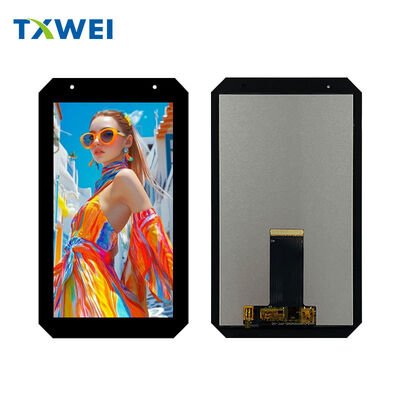
6.0 inch LTPS, 1080 × 1920, four MIPI lanes, touch inside the display stack, 6.08 mm with the cover glass. One word in the spec sheet — minimum instead of typical — changes the backlight, the thermal design and the life figure.
1080 x RGB x 1920 LTPS IPS normally black
pitch 0.023 x 0.069 mm active 74.52 x 132.48 mm
driver JD9522TS 4-lane MIPI DSI
1.8 V IOVCC VSP +4.5~6 V VSN -4.5~-6 V
48 LEDs VF 22.4~25.6 V IF 180 mA 30,000 h
1000 cd/m2 MIN uniformity 85%
LCM 82.52 x 141.92 x 4.08 mm
with CG 92.88 x 159.78 x 6.08 mmA typical figure describes the middle of the production spread: half the units are above it, half below. A minimum describes the worst unit the supplier is allowed to ship. When 1000 cd/m² appears as a minimum with 85% uniformity, the backlight has been designed with headroom, the LED binning is tighter, and the panel delivered in month eighteen still meets the number.
The cost of that headroom is thermal. A backlight built to guarantee a floor runs closer to its limit at nominal drive, which is why the 48-LED array on a 22.4–25.6 V rail deserves as much attention in the housing design as the panel itself.
02LTPS is the reason the pixel count fitsAmorphous silicon cannot place transistors small enough to drive 2.07 million pixels at 6 inches with a workable aperture ratio. Low-temperature polysilicon can, because carrier mobility is far higher and the gate driver can be formed at the edge of the glass instead of bonded as separate chips. The result is 0.023 mm across and 0.069 mm down, about 380 pixels per inch.
03Four lanes, and the arithmetic behind themOne frame at 1080 × 1920 with 24-bit colour is roughly 6.2 MB. At 60 Hz that is about 373 MB/s before protocol overhead. A single lane cannot carry that, which is why this panel needs a genuine four-lane DSI controller in the host rather than a parallel RGB port behind a bridge chip.
Host checkconfirm native 4-lane DSI and the lane rate for your frame rate before the mechanical drawing is frozen
Content checkstatic UI tolerates lower refresh; video and gradients expose banding first on reduced lane count
FPC check40 pins carry four data pairs, clock, rails and touch I2C — there is no room for an RGB bus
The specification lists no separate touch structure: the module is TFT plus cover glass. Yet the FPC carries TP_SCL, TP_SDA, TP_INT and TP_RST at 1.8 V, driven by the same JD9522TS die over I2C. No extra glass, no film sensor, no second bonding step.
The catch is the IO level. Four touch lines run at 1.8 V logic; a host with a 3.3 V IO rail needs level shifting on exactly those four lines. Teams that budgeted for a separate touch panel discover they only need four wires, and teams that assumed 3.3 V discover the mismatch a week before first boot. Both are avoidable with one schematic review.
05Two millimetres of glass, and what it buysThe LCM is 82.52 × 141.92 × 4.08 mm. Bonded with cover glass it becomes 92.88 × 159.78 × 6.08 mm — about 10 mm wider and 18 mm taller, with 2.00 mm of added thickness. That overhang carries the print, the edge treatment and the FPC exit, and 2 mm of glass survives impacts that crack 1.1 mm. It also keeps the front face flat when the housing is fastened unevenly, which is the difference between a flush panel and a visible mura patch.
| Item | Value |
|---|---|
| Display | 6.0 inch LTPS IPS, 1080 × RGB × 1920, all-direction viewing |
| Driver / interface | JD9522TS, 4-lane MIPI DSI, 1.8 V IOVCC (1.65–1.95 V) |
| Analog rails | VSP +4.5 to +6 V, VSN −4.5 to −6 V, external on FPC |
| Backlight | 48 white LEDs, VF 22.4–25.6 V, IF 180 mA |
| Luminance | 1000 cd/m² minimum, uniformity 85% |
| Touch | Integrated, I2C at 1.8 V with interrupt and reset |
| Temperature | −20 to +70 °C operating, −30 to +80 °C storage |
| Tolerance | ±0.20 mm unless specified |
The 30,000-hour figure is defined at 30 mA per LED, with a note that life drops above 35 mA. Across 48 LEDs at 180 mA total, the per-LED current sits near 3.75 mA in a series-parallel arrangement — comfortably inside that limit, which is consistent with a design built to hold a brightness floor.
Read the pair of numbers together: a supplier who guarantees a minimum usually leaves margin to keep it, a supplier who quotes a typical often does not. Ask which value you are buying and at what drive current the life was measured.
07Qualification, and the gapsStorage at +80 °C and −30 °C for 96 hours, operation at +70 °C and −20 °C for 96 hours, damp heat at 50 °C and 90% RH for 96 hours, and ten thermal shock cycles between −20 °C and +70 °C in static state. Rejection covers missing, short or unclear pixels, non-display, leakage, low-temperature bubbles, seal looseness and frame rainbow.
Absent from the list: drop, vibration, connector ESD, continuous maximum-brightness operation. For handheld and vehicle-mounted products those matter most and belong in a separate written agreement.
08Six answers before a sample is builtSpecify against the minimum, not the typical, and confirm the four integration points — lane count, IO voltage, frame rate, pocket depth — before tooling. Everything else is configuration.
Contrast ratio, response time and colour gamut are documented in the optical characteristics section of the datasheet and released with the quotation.
|
|
| MOQ: | 10 Pieces |
| Price: | Negotiable by specification and volume |
| Standard Packaging: | Anti-static tray with protective film, ESD bag, shock-proof foam, export-grade corrugated carton |
| Delivery Period: | 3-5 working days for stock, 20-25 days for mass production |
| Payment Method: | T/T |
| Supply Capacity: | 5000 Pieces per Month |
6.0 inch LTPS, 1080 × 1920, four MIPI lanes, touch inside the display stack, 6.08 mm with the cover glass. One word in the spec sheet — minimum instead of typical — changes the backlight, the thermal design and the life figure.
1080 x RGB x 1920 LTPS IPS normally black
pitch 0.023 x 0.069 mm active 74.52 x 132.48 mm
driver JD9522TS 4-lane MIPI DSI
1.8 V IOVCC VSP +4.5~6 V VSN -4.5~-6 V
48 LEDs VF 22.4~25.6 V IF 180 mA 30,000 h
1000 cd/m2 MIN uniformity 85%
LCM 82.52 x 141.92 x 4.08 mm
with CG 92.88 x 159.78 x 6.08 mmA typical figure describes the middle of the production spread: half the units are above it, half below. A minimum describes the worst unit the supplier is allowed to ship. When 1000 cd/m² appears as a minimum with 85% uniformity, the backlight has been designed with headroom, the LED binning is tighter, and the panel delivered in month eighteen still meets the number.
The cost of that headroom is thermal. A backlight built to guarantee a floor runs closer to its limit at nominal drive, which is why the 48-LED array on a 22.4–25.6 V rail deserves as much attention in the housing design as the panel itself.
02LTPS is the reason the pixel count fitsAmorphous silicon cannot place transistors small enough to drive 2.07 million pixels at 6 inches with a workable aperture ratio. Low-temperature polysilicon can, because carrier mobility is far higher and the gate driver can be formed at the edge of the glass instead of bonded as separate chips. The result is 0.023 mm across and 0.069 mm down, about 380 pixels per inch.
03Four lanes, and the arithmetic behind themOne frame at 1080 × 1920 with 24-bit colour is roughly 6.2 MB. At 60 Hz that is about 373 MB/s before protocol overhead. A single lane cannot carry that, which is why this panel needs a genuine four-lane DSI controller in the host rather than a parallel RGB port behind a bridge chip.
Host checkconfirm native 4-lane DSI and the lane rate for your frame rate before the mechanical drawing is frozen
Content checkstatic UI tolerates lower refresh; video and gradients expose banding first on reduced lane count
FPC check40 pins carry four data pairs, clock, rails and touch I2C — there is no room for an RGB bus
The specification lists no separate touch structure: the module is TFT plus cover glass. Yet the FPC carries TP_SCL, TP_SDA, TP_INT and TP_RST at 1.8 V, driven by the same JD9522TS die over I2C. No extra glass, no film sensor, no second bonding step.
The catch is the IO level. Four touch lines run at 1.8 V logic; a host with a 3.3 V IO rail needs level shifting on exactly those four lines. Teams that budgeted for a separate touch panel discover they only need four wires, and teams that assumed 3.3 V discover the mismatch a week before first boot. Both are avoidable with one schematic review.
05Two millimetres of glass, and what it buysThe LCM is 82.52 × 141.92 × 4.08 mm. Bonded with cover glass it becomes 92.88 × 159.78 × 6.08 mm — about 10 mm wider and 18 mm taller, with 2.00 mm of added thickness. That overhang carries the print, the edge treatment and the FPC exit, and 2 mm of glass survives impacts that crack 1.1 mm. It also keeps the front face flat when the housing is fastened unevenly, which is the difference between a flush panel and a visible mura patch.
| Item | Value |
|---|---|
| Display | 6.0 inch LTPS IPS, 1080 × RGB × 1920, all-direction viewing |
| Driver / interface | JD9522TS, 4-lane MIPI DSI, 1.8 V IOVCC (1.65–1.95 V) |
| Analog rails | VSP +4.5 to +6 V, VSN −4.5 to −6 V, external on FPC |
| Backlight | 48 white LEDs, VF 22.4–25.6 V, IF 180 mA |
| Luminance | 1000 cd/m² minimum, uniformity 85% |
| Touch | Integrated, I2C at 1.8 V with interrupt and reset |
| Temperature | −20 to +70 °C operating, −30 to +80 °C storage |
| Tolerance | ±0.20 mm unless specified |
The 30,000-hour figure is defined at 30 mA per LED, with a note that life drops above 35 mA. Across 48 LEDs at 180 mA total, the per-LED current sits near 3.75 mA in a series-parallel arrangement — comfortably inside that limit, which is consistent with a design built to hold a brightness floor.
Read the pair of numbers together: a supplier who guarantees a minimum usually leaves margin to keep it, a supplier who quotes a typical often does not. Ask which value you are buying and at what drive current the life was measured.
07Qualification, and the gapsStorage at +80 °C and −30 °C for 96 hours, operation at +70 °C and −20 °C for 96 hours, damp heat at 50 °C and 90% RH for 96 hours, and ten thermal shock cycles between −20 °C and +70 °C in static state. Rejection covers missing, short or unclear pixels, non-display, leakage, low-temperature bubbles, seal looseness and frame rainbow.
Absent from the list: drop, vibration, connector ESD, continuous maximum-brightness operation. For handheld and vehicle-mounted products those matter most and belong in a separate written agreement.
08Six answers before a sample is builtSpecify against the minimum, not the typical, and confirm the four integration points — lane count, IO voltage, frame rate, pocket depth — before tooling. Everything else is configuration.
Contrast ratio, response time and colour gamut are documented in the optical characteristics section of the datasheet and released with the quotation.